
Author
C-section mothers experience intense post-operative pain and do not instantly feel an emotional connection with their newborns after birth. Many also struggle with feeding, holding, and caring for their babies in the first hours or days due to physical limitations and recovery challenges.
FACT:
Modern C-sections, performed under spinal anaesthesia, are less painful, and post-operative discomfort is generally manageable with proper pain relief. Studies and experts say that C-sections do not delay mother-infant bonding; factors like maternal mental health, hospital support, and rooming-in practices play a bigger role in establishing early connection.
A viral reel posted by Aishwarya Wagh Kendre, a vlogger who is currently documenting her motherhood journey, shares a deeply personal and emotionally charged account of life after a C-section that has struck a chord with millions online. The video captures the raw aftermath of a caesarean or C-section delivery—not just the physical pain, but also the emotional distance she says she felt from her newborn in the first few hours after birth.
In the reel, Aishwarya is seen next to her newborn child. “When I woke up this morning, my child was crying next to me. It took me a while to realise that yes, I gave birth to him last night. But will you judge me if I say that I haven’t felt any emotional connection yet? Maybe because I am a C-section mom,” she says.
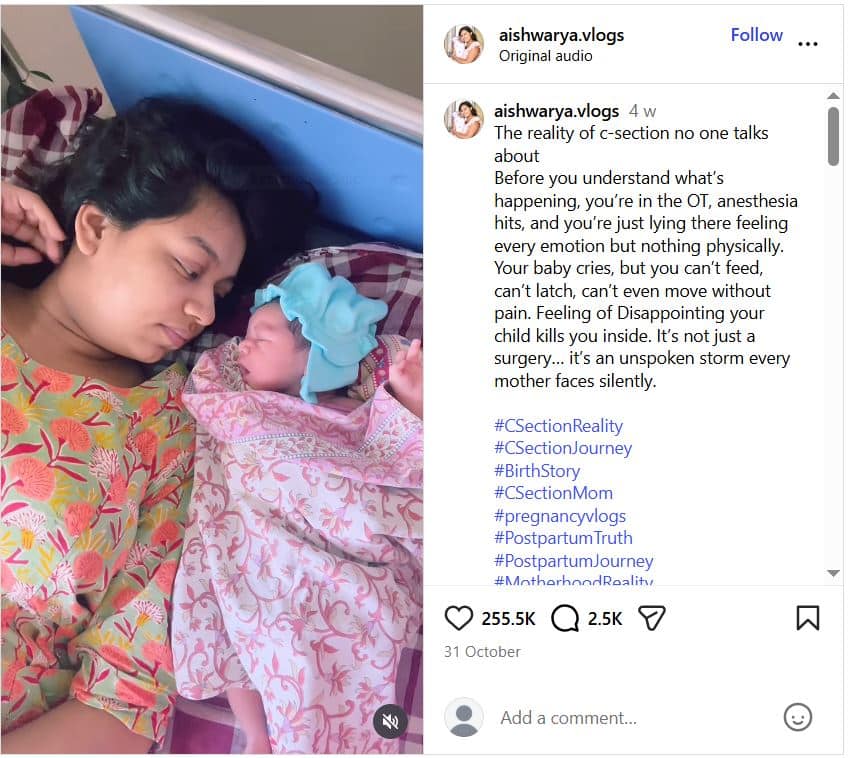
Challenging the popular belief that a mother instantly forgets all pain after seeing her baby, she adds, “People say that after delivery, you will forget all your pain and sorrows by looking at the baby’s face. But I think this is only for normal delivery moms. Because C-section mom’s pain starts after the anaesthesia.”
Describing her post-operative struggles, Aishwarya speaks about the overwhelming helplessness that follows a C-section. She adds that learning to care for a newborn, how to feed, latch, or burp the baby, is an exhausting process when your body is still recovering. Despite all her efforts, the infant still needs constant attention, leaving her feeling powerless because “you can’t even sit for a long time.”
Aishwarya also shares the physical toll of recovery, swelling on the face, syringes in her hands, and a constant dependence on painkillers. “You are hungry, but you can’t eat, and sometimes you have to wait 24 hours just to drink a sip of water. I so wonder why no one in our society talks about this phase of a C-section,” she adds.
The reel, which ends with her wishing she had been mentally and physically prepared for this phase, has garnered over 60 lakh views, 2.54 lakh likes, and 61,900 shares, sparking a nationwide conversation on the realities of recovery after a C-section.
Do C‑section mothers suffer more pain?
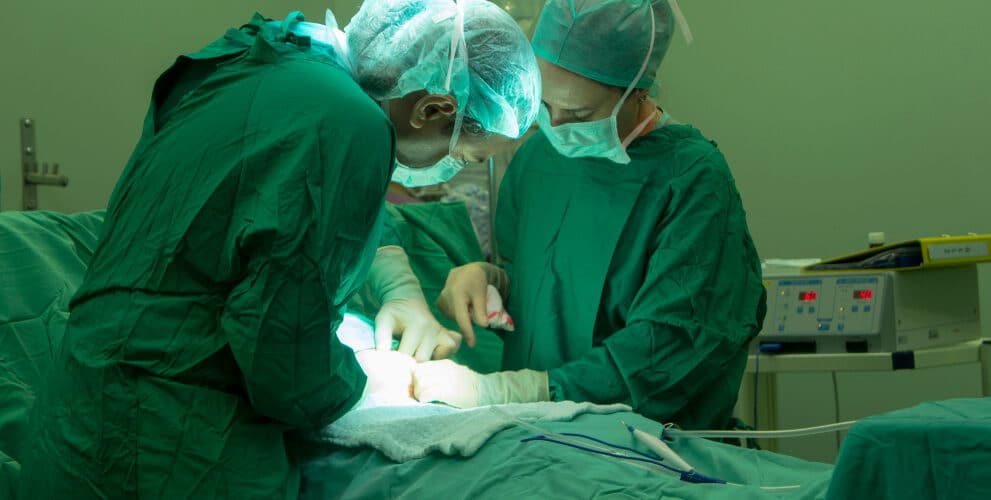
Dr Prof. Abha Majumdar, Director and Head of the Centre for IVF & Human Reproduction at Sir Ganga Ram Hospital, with 45 years of experience, explained that modern C‑sections are significantly different from the past. She noted that most procedures are now performed under spinal anaesthesia, making the surgery largely painless.
“C-section is otherwise a painless procedure. Yes, there is some post-operative pain, but if painkillers are administered adequately, patients recover quickly,” she said. Dr Majumdar added that post-operative pain after a C-section is generally manageable, and in many cases, less intense than the prolonged pain experienced during normal labour. She also emphasised that stitches from vaginal delivery can be painful for two weeks, while the abdominal scar from a C-section takes a similar period to heal.
She further explained that continuous pain relief through epidural or other analgesics ensures minimal discomfort: “We should be liberal in giving painkillers, just like during normal delivery. In two to three days, most mothers are quite normal—they walk around, use the toilet, and begin basic activities.”
Adding to this perspective, Dr Swati Rai, Consultant-Gynaecologist and Laparoscopic Surgeon at Motherhood Hospitals, Noida, clarified common misconceptions around post-C-section pain, “There’s a myth that spinal anaesthesia causes back pain, but that’s not true. Often, it’s due to how mothers sit while feeding for months or not taking proper supplements. That’s why people sometimes wrongly correlate C-section with long-term pain.”
Do C‑section mothers suffer delayed bonding with their baby?
A 2024 cross-sectional study in Eastern Poland examined 175 post-cesarean women within 13 to 72 hours after surgery, focusing on pain perception and coping strategies. The study found that cognitive coping strategies and an internal locus of control were linked to better pain reduction, while catastrophising and hoping correlated with lower coping competence.
The research said that “the necessity for the application of an individual approach to women concerning coping with pain strategies after the cesarean section as well as their own pain locus of control during women’s psychoeducation conducted by midwives and other healthcare professionals, for instance on antenatal classes. Furthermore, the results obtained suggest further investigations regarding the subject, for example, referring to the degree of pain experienced. Medical professionals’ comprehension of determinants of pain perception and ways of coping with pain used by parturients can have a positive influence on the quality of post-operative care on maternity wards.”
In terms of early infant care, a study titled ‘Does caesarean section have an impact on exclusive breastfeeding? Evidence from four Southeast Asian countries found that children born by C-section had lower odds of being exclusively breastfed compared to vaginally delivered children. The study concluded that “the findings underscore the importance of providing adequate support and interventions to mothers who deliver by CS (caesarean section) and their family members to ensure they can successfully achieve exclusive breastfeeding, particularly in a global context where CS rates are rising.”
Another 2023 observational study investigating the relationship between severe postpartum pain and maternal-infant bonding found that pain intensity did not significantly affect bonding outcomes in either vaginal or cesarean deliveries. Instead, factors such as maternal mental health and rooming-in practices were stronger predictors of bonding. The study concluded that contrary to expectations, severe postpartum pain “did not influence maternal-infant binding in the cohort of patients with vaginal and cesarean deliveries”. Instead, factors such as “maternal mental health and rooming-in practices appeared to exert more significant influence.”
Addressing concerns about mother-infant bonding, Dr Majumdar said, “Bonding is not delayed because of C-section. The mother is awake, fully aware, and can hold the baby immediately after delivery. We put the baby to the breast while the mother is still in the operating room after the placenta is delivered.”
She contrasted this with experiences during normal delivery, where mothers may sometimes delay holding the baby due to labour exhaustion, “After a vaginal delivery, some mothers are in so much pain that they say, ‘Take the baby away, I just want to rest.’ But after a C-section, mothers are generally happy to hold their babies because the delivery itself is painless.”
Dr Majumdar also clarified that bonding depends on individual circumstances, hospital protocols, and postnatal support, not the mode of delivery. “It is a personal experience if someone feels bonding is difficult. Adequate post-operative care, pain management, and allowing rooming-in ensure bonding happens naturally,” she said.
She concluded, “Both normal and C-section deliveries have their pros and cons. With modern anaesthesia and pain management, C-section is practically safe, and mothers can bond with their babies right after birth.”
Adding to this, Dr Rai provided a complementary perspective on the gradual nature of bonding, “Bonding takes time. Initial struggles with feeding or latching are normal for all mothers, regardless of delivery method. The connection with your baby develops gradually as you learn together.”
Also read: World Breastfeeding Week is here, but have we checked on our mothers and the data?
(Do you have a health-related claim that you would like us to fact-check? Send it to us, and we will fact-check it for you! You can send it on WhatsApp at +91-9311223141, mail us at hello@firstcheck.in, or click here to submit it online.