
Author
Vaccination has transformed public health, saving millions of lives and preventing severe illness and death from infectious diseases. Yet, despite decades of progress, significant gaps in immunisation coverage remain, with millions of people still missing out on essential vaccines.
According to the WHO, “Globally in 2025, 13.5 million children were missing out on any vaccination – so-called zero-dose children.” At the same time, vaccination is increasingly important beyond childhood. The WHO notes that the world’s population is rapidly ageing and that, by 2030, nearly 1 billion people are expected to be aged 65 and above. Yet adult vaccination remains an overlooked public health tool, particularly in low- and middle-income countries where immunisation programmes have traditionally focused on children, adolescents and women of reproductive age.
Alongside these coverage gaps, misinformation and misconceptions about vaccines continue to influence how people understand and make decisions about immunisation, creating another challenge for vaccination programmes.
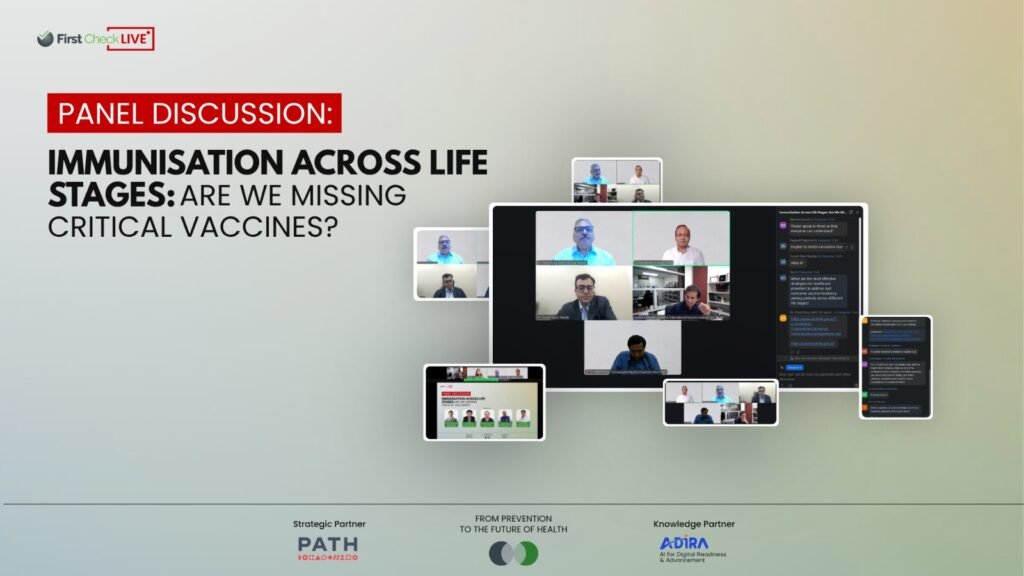
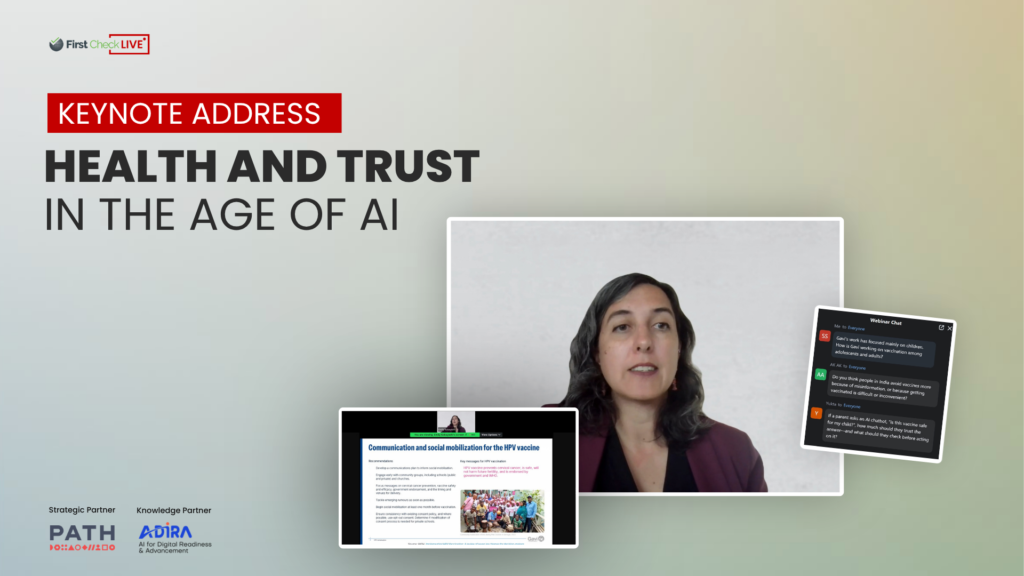
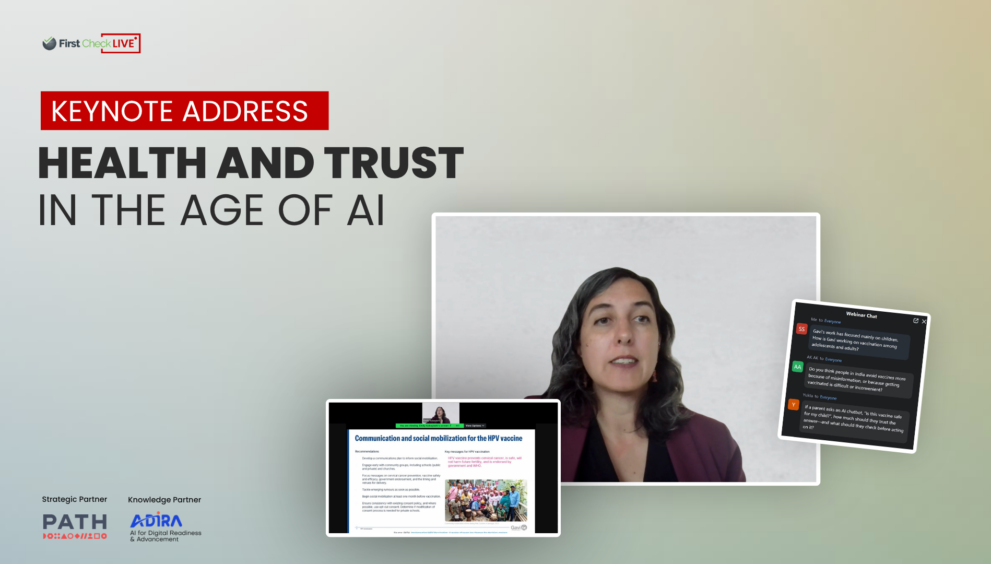
Against this backdrop, speaking at First Check LIVE’s third episode, ‘Immunisation Across Life Stages: Are We Missing Critical Vaccines?’, held on Wednesday, Emily Kobayashi, Director, Vaccine Programmes, Gavi, discussed the need for life-course vaccination, the challenges of building vaccine trust, and the growing role of misinformation and AI in shaping vaccine decisions.
Vaccination must span life stages
Kobayashi said vaccination programmes need to increasingly look beyond infancy and reach people at different stages of life, including adolescents, adults, pregnant women and older people. She explained that while traditional immunisation programmes have built decades of familiarity around childhood vaccines, newer vaccines require people to understand why they are being offered at different points in life.
“At our inception in 2000, we supported protection against six infectious diseases, and today that number has actually exceeded 20 different diseases that we’re protecting against,” she said, describing how Gavi’s vaccine portfolio has expanded over time.
She said this shift towards life-course vaccination also brings new questions from caregivers, health workers and communities. People may naturally ask why an adolescent needs a particular vaccine, why a newborn should receive a vaccine within 24 hours of birth, or why a woman should be vaccinated during pregnancy.
“These are perfectly natural questions that people making decisions about the choice to take a vaccine will have,” Kobayashi said. “We don’t have that decade of experience, habit and custom around vaccinating at these different points in the life course.”
According to Kobayashi, building trust will therefore be critical as vaccination expands beyond the childhood immunisation schedule. She pointed to social media, global information networks, the politicisation of health information and wider concerns around multiple crises as factors shaping public trust.
Misinformation is evolving
Kobayashi said misinformation has become increasingly difficult to navigate as social media allows rumours and false claims to travel rapidly across borders. Influencers can also play a role, particularly when they profit from spreading misinformation or creating doubt about vaccines.
She noted that the COVID-19 pandemic provided a particularly clear example of how vaccine information and misinformation could become globally interconnected.
“AI is capable of generating very convincing content, where AI, in some cases, provides trustworthy information, but also can be a multiplier of disinformation that’s in the Internet,” she said.
Kobayashi also cautioned against assuming that misinformation alone explains why people do not get vaccinated. In some settings, low vaccination coverage may instead reflect problems with access, cost, availability or simply not knowing where a vaccine is offered.
“It’s a shortcut. And it’s inaccurate to say that areas of low coverage is because of acceptance of misinformation or because of some inherent resistance to vaccines,” she said.
She added that improving service delivery can have a significant effect on whether parents are able to access vaccines.
Can AI be trusted?
With AI increasingly becoming a source of health information, Kobayashi said its reliability depends on how the system has been developed and what information it draws from.
“There are some AI chatbots that have been developed and trained to provide accurate information,” she said, adding that some are trained on guidelines or existing communication materials. AI could also potentially be used to support services such as toll-free health hotlines, allowing people to ask questions and receive information.
However, she cautioned that this does not mean that every AI system can be trusted to provide accurate vaccine information.
“We should not expect that every AI has the same level or proclivity towards providing accurate information. That is not the case,” she said.
Kobayashi explained that systems that search across the internet can encounter both reliable and unreliable information.
“Some AIs search the whole Internet. And if you search the whole Internet, you will find all sorts of, you know, unvalidated claims, disproven claims presented as if they were true,” she said. “The AI doesn’t have the ability to sift through those. It looks at frequency. It looks at likelihood.”
For this reason, she said, specifically validated AI tools may have potential for providing accurate vaccine information, while users should not automatically assume that every AI chatbot is reliable.
Lessons from HPV vaccination
Kobayashi said Gavi’s experience with the rollout of the HPV vaccine offers an important example of how vaccination programmes can prepare for misinformation and build trust.
She said “GAVI’s effective communication has focused on these key messages – that the HPV vaccine protects against cervical cancer, that it is safe, it is endorsed by government and WHO and that it does not harm fertility. Early engagement with community groups and the preparation of a crisis communication plan were also important, particularly because rumours could begin circulating before a vaccine was introduced.”
“Every country that introduced the HPV vaccine faced rumours and pushback, but we had to have an approach to addressing those rumours as soon as possible,” she said.
Kobayashi highlighted the role of civil society organisations, healthcare professionals, cancer advocates, religious leaders and other trusted community messengers in responding to questions and rumours in locally relevant ways. She said these groups need to be equipped with accurate information so they can respond quickly when concerns emerge.
Reflecting on the broader challenge, she said misinformation is likely to remain part of the vaccine landscape, particularly as AI tools and digital networks evolve. But she stressed that health systems already have experience in responding to it.
“Misinformation is there. It’s a challenge. It is going to become exacerbated by some of these new AI tools and these new networks of influencers who see the opportunity to have profit in spreading misinformation,” Kobayashi said.
“But we (GAVI) also have decades of experience of how to respond to this type of misinformation, and we shouldn’t hesitate to deploy it.”