Author
Vaccination is often seen as a childhood matter. In India, that view may be leaving many adults without protection against diseases that can be prevented.
A 2025 study in BMC Public Health screened 7,097 adults in New Delhi between April 2021 and August 2022. It found that 93.3 percent of them reported “not receiving even a single dose of the Hepatitis B vaccine”. Only 4.4 percent were fully vaccinated. Yet 85.5 percent said they were willing to take it, and only 25 percent knew that the vaccine was an effective way to prevent the infection.
A 2022 paper in the Indian Journal of Community Medicine pointed to a similar gap in awareness. The authors wrote that most of the general public and a substantial share of health workers in India “lack awareness on the availability and need for these adult vaccinations”. They added that as childhood immunisation improves and people live longer, many diseases are now showing up later in life.
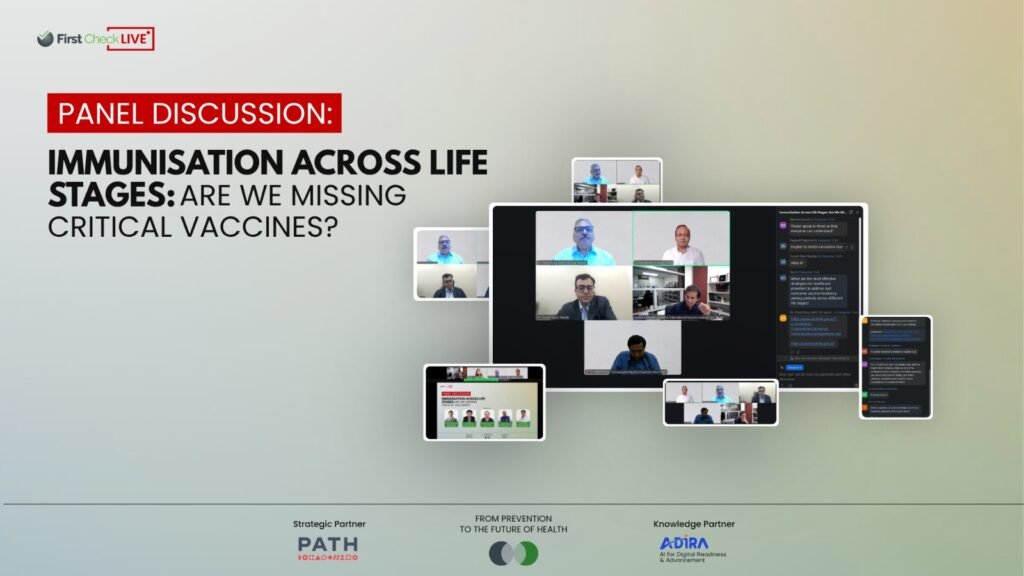
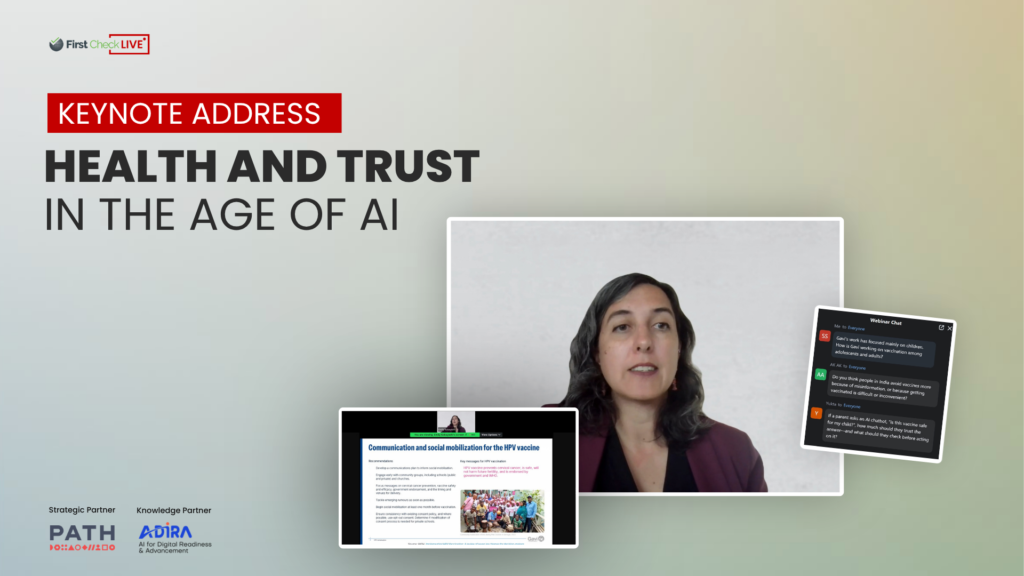
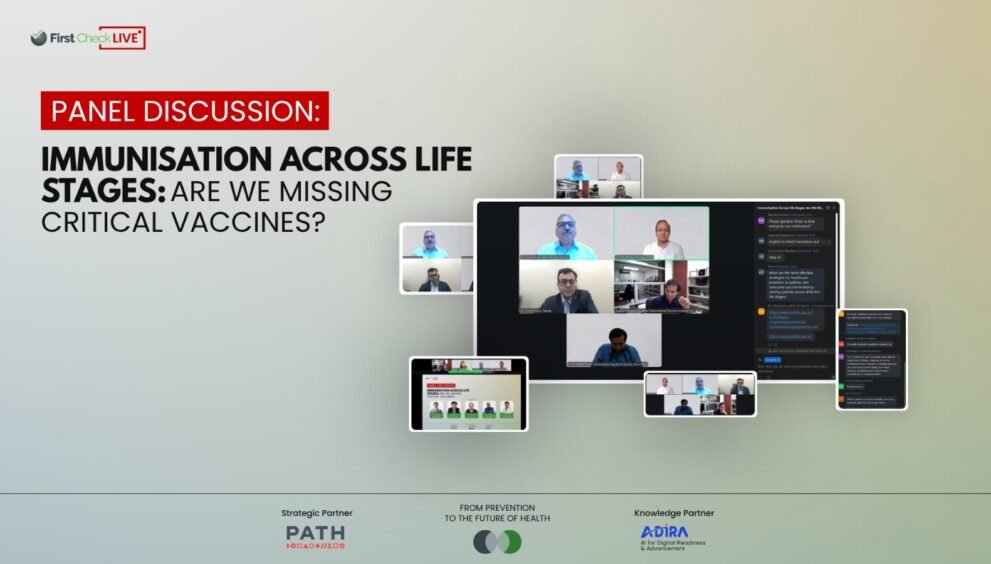
Against this backdrop, First Check LIVE hosted a panel discussion on Wednesday titled Immunisation Across Life Stages: Are We Missing Critical Vaccines? The online session, held from 3 pm to 4.30 pm, was the third dialogue in the Health and Trust in the Age of AI series.
First Check LIVE is an initiative of First Check, a global health information platform that brings together scientists, doctors and journalists to make reliable, evidence-based health information more accessible.
The discussion was moderated by Dr Satyabrata Routray, Director of Communicable Diseases, South Asia, at the Program for Appropriate Technology in Health (PATH).
The panellists were Sushant Sahastrabuddhe, Deputy Director General (Acting) at the International Vaccine Institute; Dr Puneet Kalra, Country Medical Lead for Vaccines, India and Sri Lanka, at Takeda Biopharmaceuticals India Private Limited; Dr Nikhil Modi, Senior Consultant, Pulmonology and Critical Care, at Indraprastha Apollo Hospitals, New Delhi; and Dr Vinod Bura, Coordinator, Immunization and Vaccine Development, at the World Health Organization’s South-East Asia Regional Office in New Delhi.
The panel set out to examine India’s immunisation gaps, new vaccine opportunities, and the challenge of reaching children who have never had a routine vaccine and communities that health services have missed. It also looked at what holds back confidence and access, and what it takes to strengthen vaccination across a lifetime, from the HPV vaccine and vaccination during pregnancy to vaccines for adults and older people.
Opening the discussion, moderator Dr Satyabrata Routray noted that vaccine-preventable diseases were on the rise. “So why only children?” he asked.
Finishing the job on childhood vaccines
Dr Vinod Bura of the World Health Organization said immunisation had saved about 154 million lives worldwide in the last 50 years. Every dollar invested returns 54 dollars, he said. “It’s a very strong economic case,” he stated.
Yet about 85 percent of children worldwide receive the third dose of the “DPT” vaccine, Dr Bura pointed out, leaving 13 million to 14 million without it.
In India, he explained, the last 10 percent of children are the hardest and costliest to reach because they live in remote areas, weak health systems or hard-to-identify communities. Under Mission Indradhanush, 143 districts in 11 states have been identified for focus on children who are under-vaccinated or have received no dose.
Sushant Sahastrabuddhe of the International Vaccine Institute outlined three priorities: finishing childhood vaccination, scaling up new vaccines and building for those in the pipeline. The “HPV” vaccine rollout began earlier this year, he noted, and India switched from “TT” to “Td” in February.
He said India has no clear national plan to introduce the “typhoid conjugate” vaccine. “Every one of these vaccines, they succeed or fail based on the delivery and supply,” he stressed.
Technology, trust and hesitancy
Dr Bura said authorities are working to track every unvaccinated child through the U-WIN platform. Sahastrabuddhe added that adult immunisation still sits outside it and called for a national digital registry.
On artificial intelligence, Dr Bura cautioned, “AI can help to some extent, but we should not trust it blindly.”
Dr Puneet Kalra of Takeda Biopharmaceuticals India said confidence is fragile. “It takes years and years to build vaccine confidence, but it just takes a moment of misinformation to shatter that confidence and then vaccine hesitancy sets in,” he said.
Among remedies, he listed a strong recommendation from the vaccinating doctor or an ASHA worker, and a “truth sandwich” that answers misinformation with facts instead of fighting it.
The adult gap
“We don’t really have a very good track record of adult immunisation in India,” Sahastrabuddhe remarked, adding that pneumococcal coverage among adults above 45 is probably below 1 percent.
Dr Nikhil Modi of Indraprastha Apollo Hospitals said childhood vaccination has clear guidelines but has not become an adult programme. He cited an ageing population, diabetes, cancers and pollution-related lung disease as reasons adults face more infections and hospitalisations.
“Influenza” and “pneumococcal” vaccines are recommended internationally above 65, he said, but India lacks clear guidelines. Cost is also a barrier. “Indian population is not that affordable,” he observed.
On what makes a vaccine critical, Dr Bura explained that an independent advisory body weighs disease evidence, economics and equitable delivery. “It’s very complex, very competitive, and I would say has to be a very transparent process,” he said.
Many adults, Modi recalled, do not know vaccines exist for them. “When you talk to them about vaccines, they say, ‘ It is for kids; why are you giving it to us?” he said.
Summing up, Dr Routray said, “Adult life course immunisation is so very crucial and critical for India”, citing the growing ageing population.