Author
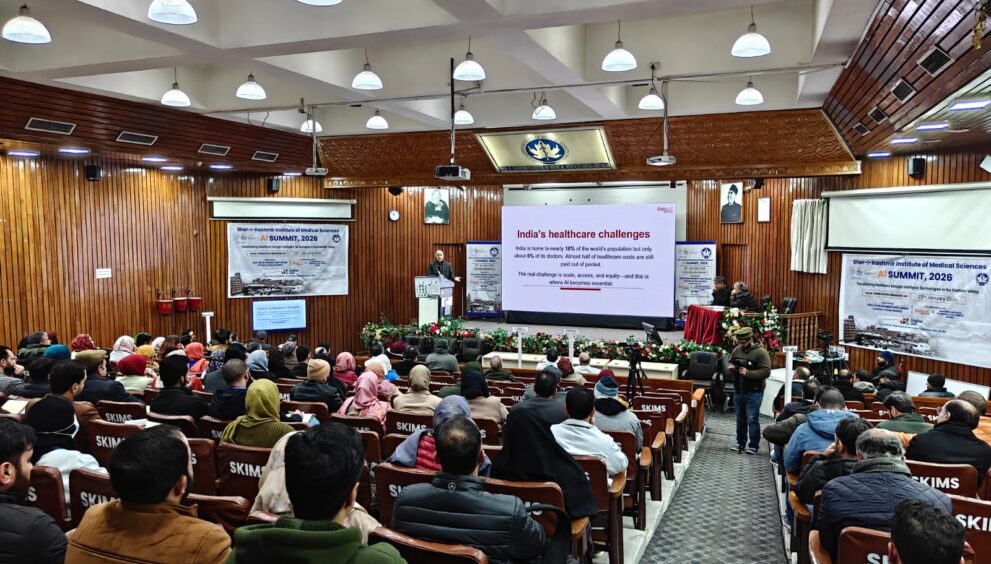
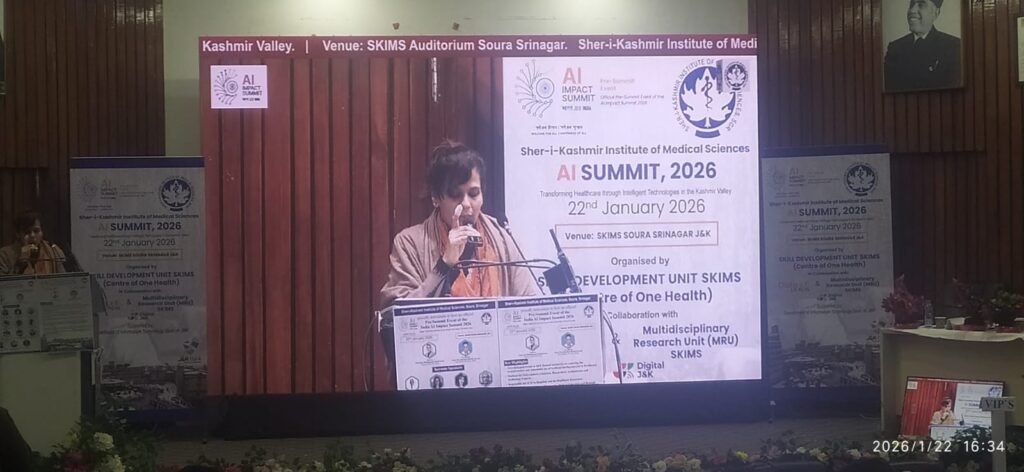
Artificial intelligence has moved from being a futuristic concept to an indispensable tool for addressing India’s deep-rooted healthcare challenges of scale, access and equity, experts said at the Official Pre-Summit of the India AI Impact Summit 2026, hosted by the Sher-i-Kashmir Institute of Medical Sciences (SKIMS) in Srinagar on Thursday.
Setting the tone for the day-long summit, Syed Nazakat, Founder and CEO of DataLEADS, said India’s healthcare burden far outstrips its human resources, making technology-led solutions unavoidable.
“India has 18 percent of the world’s population but only 6 percent of its doctors. Almost half of healthcare costs are still paid out of pocket. The real challenge is scale, access and equity — and this is where AI becomes essential,” Nazakat said while presenting a detailed overview of AI-driven healthcare transformation in India.
He described artificial intelligence as the first technology in human history capable of making autonomous decisions, marking a fundamental shift from machines as passive tools to active collaborators in healthcare delivery. AI, he said, is already reshaping health systems by analysing complex data, detecting diseases earlier, reducing misdiagnosis in primary care, recommending treatments and predicting outcomes.
Highlighting gaps in India’s health data ecosystem, Nazakat pointed out that the country still lacks reliable information on causes of death for most of its population. Citing data from the Indian Council of Medical Research (ICMR) and the Registrar General of India, he said only about 22.5 percent of deaths in India are medically certified.
“Hospital deaths are the exception in India. Most deaths occur at home and in rural areas,” he said, referring to findings from the Million Deaths Study led by Prof. Prabhat Jha of the Centre for Global Health Research, Toronto.
Nazakat said artificial intelligence can help bridge these blind spots by strengthening health information systems and enabling predictive, preventive and personalised care models, in line with India’s vision of Health for a Viksit Bharat by 2047. While AI research in healthcare is not new, he said, what has changed is the scale, speed and real-world impact it can now deliver.
Citing market projections, Nazakat noted that India’s AI-in-healthcare market is expected to grow from $758.8 million in 2023 to $8.7 billion by 2030, reflecting both opportunity and urgency. However, he cautioned that technology alone will not suffice without widespread skilling and AI literacy among doctors, nurses, administrators and public health workers.
The summit, held under the theme “Transforming Healthcare through Intelligent Technologies in the Kashmir Valley,” placed Jammu and Kashmir among the select regions shaping India’s AI-driven healthcare future. The event brought together policymakers, global experts, academicians and healthcare leaders from institutions including Harvard University, Johns Hopkins Bloomberg School of Public Health, AIIMS and IITs.
Addressing the gathering virtually, Prof. V. K. Paul, Member, NITI Aayog, outlined the integration of AI within India’s health systems, highlighting its growing role in diagnostics, telemedicine, service delivery, capacity building and flagship initiatives such as Ayushman Bharat.
“Given the complexity and scale of India’s public health landscape, artificial intelligence can significantly enhance decision-making — from precision interventions to local-level action and forecasting,” Prof. Paul said, while commending SKIMS and its leadership for their contribution to healthcare.
Chief Guest Padma Awardee Prof. Digambar Behera, President of the National Academy of Medical Sciences (NAMS), said AI is redefining disease diagnosis and treatment through precision medicine and improved clinical decision-making.
Director SKIMS and EOSG, Prof. Mohd Ashraf Ganie, said the institute is poised to emerge as a regional hub for artificial intelligence in healthcare, with the goal of transforming health systems across Jammu & Kashmir and Ladakh. He announced that SKIMS has launched a new Department of Clinical Repository Information & Technology to strengthen data readiness, enhance research capacity and support ethical AI-driven healthcare delivery.
“AI is already circumventing many traditional pathways in drug discovery, diagnostics and patient data utilisation. It has revolutionised patient care in areas such as diabetes management, making interventions faster, more precise and clinically efficient,” Prof. Ganie said, while stressing that the human interface will remain central to compassionate and ethical care.
Guest of Honour Dr. Piyush Singla (IAS), Secretary, Department of Information Technology, J&K, said SKIMS has the clinical depth and institutional expertise to position Jammu and Kashmir as a national reference point in AI-driven healthcare. Deputy Commissioner Srinagar, Akshay Labroo, assured full administrative support and said district-level databases are already operational, enabling future collaboration.
The summit featured plenary sessions and panel discussions on AI in healthcare delivery, research priorities in digital health, AI-driven transformation in India, and applications in cancer research and genetics.
Concluding the event, Urvashi Kaul, delivering the vote of thanks, said the summit marked the beginning of a long-term collaboration rather than a one-off discussion. “The consensus today was clear — AI will largely be an enabler. It will support human expertise, not replace it,” she said.
She emphasised the need for AI literacy and institutional readiness across all levels of the healthcare system and stressed that while data is often described as the “new oil,” its true value lies in responsible, secure and inclusive use. Kaul added that institutions like SKIMS have a critical role in shaping India’s AI healthcare ecosystem and said DataLEADS remains committed to supporting this journey.
The event was organised by the Skill Development Unit (Centre of One Health), SKIMS, in collaboration with DataLEADS and the Multidisciplinary Research Unit (MRU), with support from the Department of Information Technology, J&K. SKIMS is among a select group of institutions nationwide chosen to host Official Pre-Summit events ahead of the India AI Impact Summit 2026, which will culminate in New Delhi.
Also read: India bets on AI to expand its public healthcare mission
(Do you have a health-related claim that you would like us to fact-check? Send it to us, and we will fact-check it for you! You can send it on WhatsApp at +91-9311223141, mail us at hello@firstcheck.in, or click here to submit it online)