

Author
CLAIM:
Naturopathy and autophagy can significantly aid cancer recovery.
FACT:
False. Naturopathy and autophagy do not cure cancer. Experts note that any benefits are limited to supportive care or managing side effects, and there is no evidence that these approaches can increase survival. They should not be considered a substitute for proven medical treatments like surgery, chemotherapy, or radiation.
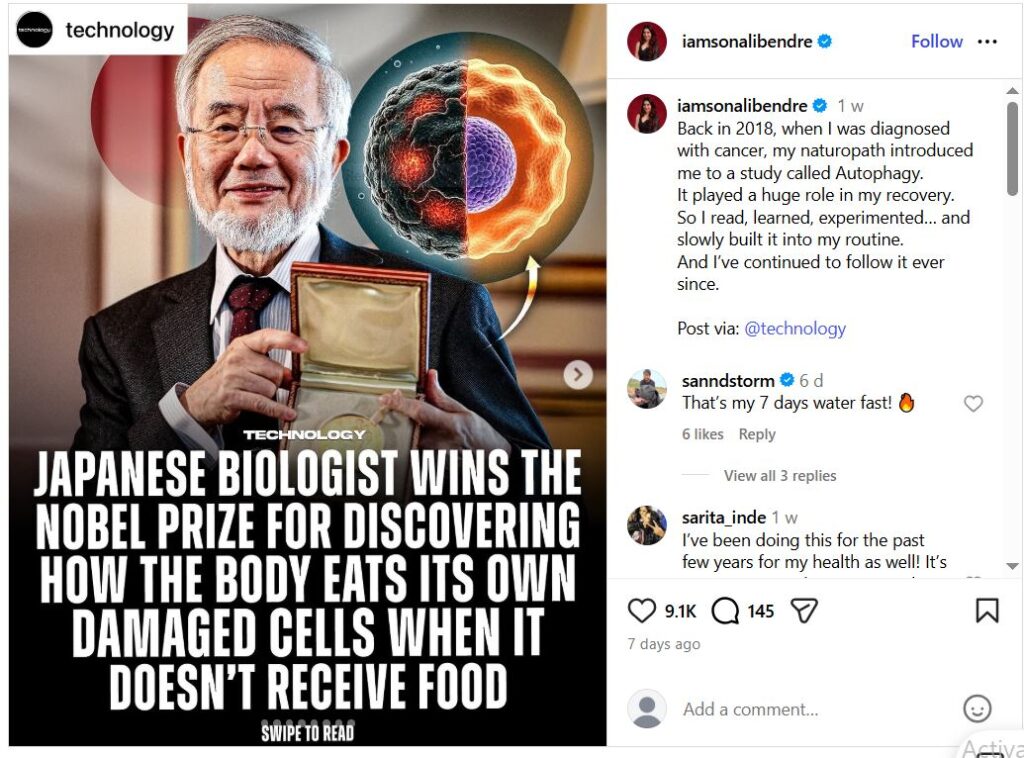
Actress Sonali Bendre’s claim of naturopathy and autophagy helping her recovery from cancer is going viral and has sparked a highly debated conversation across social media platforms. For context, Sonali Bendre shared a post on Instagram claiming that autophagy, a process commonly associated with fasting, cell renewal and some alternative healing practices, played a huge role in her recovery.
In her Instagram carousel, she wrote, “Back in 2018, when I was diagnosed with cancer, my naturopath introduced me to a study called Autophagy. It played a huge role in my recovery. So I read, learned, experimented… and slowly built it into my routine. And I’ve continued to follow it ever since.”
Her post quickly faced backlash from several medical professionals who criticised it for promoting quackery, noting that naturopathy and autophagy are unproven as treatments for cancer.
However, in response to the criticism, Sonali posted a clarification on X, stating that she was only sharing her personal journey and not prescribing alternative medicine.
Her statement read, “I have never claimed to be a doctor, but I am certainly not a quack either. I am a cancer survivor, someone who has lived through the fear, pain, uncertainty, and rebuilding that the disease brings.”
She added, “Everything I have ever spoken has been my experience and my learning. As I have repeatedly said, no two cancers are the same and no treatment path is identical. One of the many protocols I personally explored, after thorough research and medical guidance, was autophagy. It made a difference for me then and continues to do so today, for me.”
She further said, “What truly matters is open, respectful dialogue. We do not all have to agree, but we should avoid dismissing one another simply because we lean toward different approaches. Each person must choose what feels right, safe and empowering for them. I will always share my journey with honesty and humility, never as a prescription, but as a lived experience.”
Considering that these claims have again created confusion in the minds of people about whether naturopathy or autophagy can actually help in cancer recovery, First Check decoded the claim to verify whether these therapies play any proven role in cancer treatment.
What are naturopathy and autophagy?
Naturopathy is a holistic system of health that relies on natural practices such as diet changes, exercise, massage, herbal remedies and lifestyle modifications to support the body’s ability to heal itself. It focuses on overall wellness rather than treating specific diseases.
Autophagy is a biological process in which the body breaks down and recycles old or damaged cell components. It is essentially the body’s internal cleanup mechanism and plays a role in cell repair, metabolism and survival during periods of stress.
Autophagy can be triggered by certain physical and metabolic stressors. These include fasting, which deprives the body of nutrients and encourages cells to recycle internal components; calorie restriction, which limits energy intake and pushes cells to compensate by activating autophagy; high-fat, low-carbohydrate diets such as the ketogenic diet, which shift the body’s energy source from carbohydrates to fats; and exercise, which places controlled stress on muscles and can activate autophagy pathways depending on the type and intensity of the workout.
However, the ability to induce autophagy does not mean it is always advisable or safe. Practices like fasting, strict calorie restriction or adopting a keto diet may pose risks for people who are pregnant, breastfeeding or living with conditions such as diabetes. Similarly, starting an intense exercise routine without medical guidance can also be harmful. Any attempt to trigger autophagy should therefore be done carefully and ideally under the supervision of a healthcare professional.
Does naturopathy aid in cancer recovery?
The US FDA has issued multiple warning letters against illegally sold natural cancer cures, with naturopathy frequently appearing in these lists. In several countries, naturopaths are legally barred from promoting treatments for cancer. Former naturopath Britt Marie Hermes, once an advocate of alternative medicine, left the field after witnessing unethical practices and now runs a blog where she openly calls naturopathy “essentially witchcraft”, adding that “naturopathic medicine has too much quackery.”
India has seen multiple controversies around claims that diet or naturopathic methods cured cancer. When Navjot Singh Sidhu claimed that his wife overcame stage four cancer through a strict diet regimen, oncologists across the country clarified that such statements risk spreading harmful misinformation.
The Tata Memorial Hospital had issued a detailed rebuttal, stating, “A video of a former cricketer describing his wife’s treatment for her breast cancer has been circulating widely on social media. Parts of the video imply that “starving the cancer by not eating dairy products and sugar”, consuming haldi (turmeric) and neem helped cure her “incurable” cancer. These statements have no high-quality evidence to support them. While research is ongoing for some of these products, there is no clinical data currently to recommend their use as anti-cancer agents. We urge the public not to delay their treatment by following unproven remedies, but rather to consult a doctor, preferably a cancer specialist, if they have any symptoms of cancer. Cancer is curable if detected early, and proven treatments for cancer include surgery, radiation therapy and chemotherapy.”
Former NITI Aayog Director Dr Urvashi Prasad had also responded on LinkedIn, writing, “It must be emphasized that no evidence currently exists about any particular diet ‘curing’ cancer. Mr Sidhu’s wife received all standard medical treatments (surgery, chemotherapy, radiation and possibly immunotherapy too), making his claims highly misleading.”
In fact, 262 oncologists from Tata Memorial Hospital had collectively urged the public “not to delay their treatment by following unproven remedies, but rather to consult a doctor, preferably a cancer specialist, if they have any symptoms of cancer.”
Supporting the same point, Dr Sameer Kaul, Senior Consultant in Surgical and Clinical Oncology at Apollo Cancer Institute, told First Check earlier that, “Well, diet is important in every ailment, including cancer. But claiming that diet alone cured metastatic cancer is a fallacy, and it is misinformation.”
Scientific literature also highlights risks associated with naturopathic approaches. A key study examining women with breast cancer found that those who opted for adjunctive naturopathic oncology had worse disease-free survival compared to patients who received standard oncology care alone. The study raises significant questions for integrative oncology as a whole, and particularly for complex integrative systems like naturopathy that routinely incorporate multiple lifestyle and herbal or supplemental interventions.
Does autophagy aid in cancer recovery?
Autophagy is a real cellular recycling process essential for maintaining cell health. It is an active area of cancer research, but its role is far more complex.
A 2018 review examining fasting and autophagy during cancer treatment noted, “Fasting may protect normal cells from the toxicity of anticancer agents, reducing side effects in patients and increasing the detrimental effects of chemotherapy, radiotherapy and targeted therapy on tumour cells. However, additional studies are required to better understand the molecular mechanisms evoked by fasting, aiming to identify the context in which fasting may be beneficial as an adjunct to cancer treatment.”
Several clinical trials are currently evaluating intermittent fasting or fasting-mimicking diets in cancer patients, but no large, randomised studies have yet shown improvements in survival or recovery outcomes.
A 2023 review further underscores the complex and sometimes contradictory role of autophagy in cancer. While autophagy is generally thought to both suppress tumorigenesis and promote tumour growth, the review notes that “there exist some conflicting reports.”
“Liver tumours formed by ATG5 deficiency are benign. Furthermore, the frequency of ATG gene mutations is not very high in liver cancer,” the review points out.
The authors emphasise that “further studies are required to determine whether mutations in ATG proteins are actually associated with tumorigenesis in human cancer.” They also highlight that “autophagy promotes tumour growth in pancreatic ductal adenocarcinoma (PDAC) but suppresses it under PTEN deficiency,” illustrating that its effects vary depending on cancer type and context. Overall, the review concludes that individual studies are necessary to fully understand autophagy’s role in different cancers.
What experts say
Dr Gaurav Jaswal, Director and Consultant Radiation Oncologist at TGH-Onco Life Cancer Centre, Maharashtra, emphasised that there is currently no credible clinical evidence supporting claims that naturopathy or autophagy can increase cancer survival.
“So far, there has been no robust study in any cancer that substantiates the fact that these remedies will lead to increased survival, whether it’s breast cancer or any other type. All these things are for supportive purposes right at this point,” he said.
He added that while some naturopathic interventions may help manage side effects of conventional treatment and improve quality of life, the evidence is limited. “There is some evidence that they may help patients get a better quality of life management with the disease or the side effects of treatment. But I would certainly not agree that there is any survival benefit with these measures.”
Dr Jaswal also highlighted the risks of delaying conventional treatment due to reliance on unproven methods.
“Today, I have seen two patients whose early-stage, curable cancers progressed to stage 4 because they followed these naturopathic practices and misinformation. Winning the battle against cancer through such measures is illusory,” he shared.
On the best approach to cancer treatment, he advised that the best way to treat cancer is to consult a proper oncologist and undergo appropriate oncological diagnosis and treatment. “Following oncological principles gives patients the best chance of a cure,” he said. “Once cancer occurs, these are the methods, like chemotherapy and radiation, that help us cure many patients today.”
He did, however, acknowledge the value of healthy lifestyle measures for prevention. “If you do fasting, exercise well, maintain weight, and avoid addictions, a disciplined life can help prevent such diseases,” he advised. “But once cancer has occurred, proper oncological care is essential.”
Also read: Fact check: Can hot water baths really treat cancer?
Do you have a health-related claim that you would like us to fact-check? Send it to us, and we will fact-check it for you! You can send it on WhatsApp at +91-9311223141, mail us at hello@firstcheck.in, or click here to submit it online.