Author
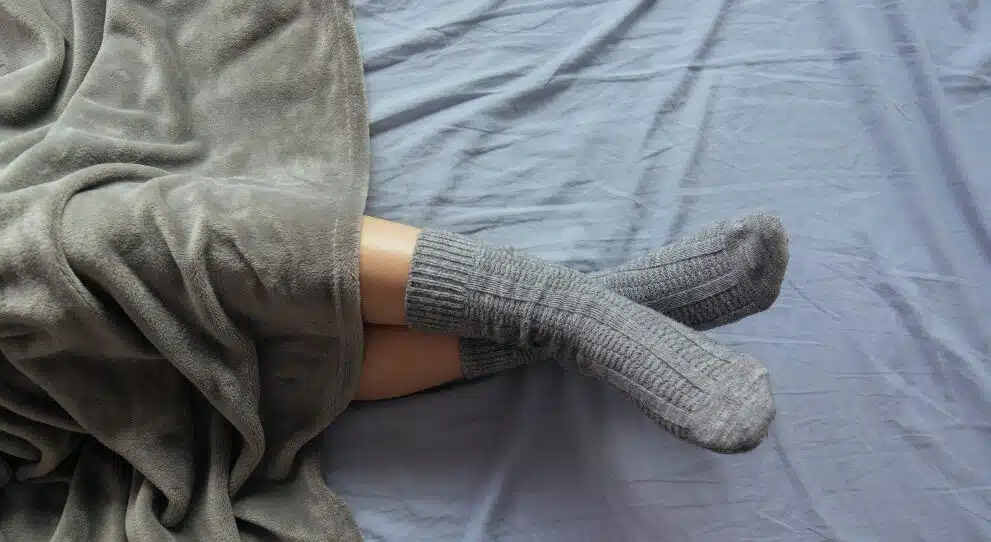
CLAIM: A viral Instagram reel claims warming the feet before bed, via socks or a heating pad, helps you fall asleep 15-20 minutes faster by triggering heat loss through dilated blood vessels, which lowers core body temperature. It claims cold feet delay sleep by 25 minutes and shorten deep sleep, citing “Swiss researchers from the University of Bern.”
FACT: Warming the feet before bed helped some people fall asleep faster by encouraging blood flow and heat loss, though the effect varied by person. Controlled research found warming socks cut sleep onset by roughly 7.5 minutes, not the 15-20 minutes often claimed. Benefits depended on age, room temperature and how cold the feet were. Sleeping in loose, breathable socks was generally considered safe.
An Instagram account, ibojenko, which has 53.1K followers, shares a reel claiming that wearing socks to bed is backed by science rather than being just an old “grandma’s tip.” The reel has garnered more than 107,000 likes, 825 comments and has been reposted more than 1,300 times.
The caption begins by framing the claim as counterintuitive, stating, “the body works by the laws of physics, not by sensations,” before claiming that “Swiss researchers from the University of Bern conducted a study and found that warm feet actually help you fall asleep 15–20 minutes faster and improve sleep quality,” and adding that “the mechanism turned out to be purely physiological, not psychological.”
It goes on to claim that the body’s temperature “needs to drop by 1–2 degrees” to fall asleep, and that this heat is released “through the extremities” as “blood vessels in the hands and feet dilate.” It states, “if your extremities are cold, the vessels constrict and heat cannot leave,” calling this “the paradox,” because the body has to first warm the feet in order to eventually cool down.
The reel also cites a specific figure for people who do not follow this advice, claiming, “People with cold feet take about 25 minutes longer to fall asleep on average, and their deep sleep phase is shorter.”
The caption ends by recommending that viewers put on socks before bed: “You can put them on before bed and take them off after you fall asleep.” It offers an alternative too: “Or use a heating pad on your feet for 20 minutes before bed.” It concludes: “A simple thing, but behind it lies an entire mechanism.”
What does the study say?
A 2018 study published in the Journal of Physiological Anthropology tested whether wearing bed socks actually improved sleep in a cool room. Six young men slept for seven hours at 23°C, once with bed socks and once without, and researchers tracked their sleep patterns using a wrist device along with body temperature readings through the night.
The results favoured the socks. Participants fell asleep 7.5 minutes faster, slept 32 minutes longer overall, and woke up 7.5 times less often when wearing bed socks, compared to sleeping barefoot. Their foot temperature also stayed 1.3°C warmer through the night.
However, there was no real difference in heart rate or core body temperature between the two nights, and participants themselves didn’t report feeling any different the next morning. As the study concluded, “sleep quality could be improved by manipulation of the foot temperature throughout sleeping,” even without a noticeable shift in how warm the body felt overall.
A more recent study, published in 2025 in the Journal of Sports Medicine and Physical Fitness, tested the effect of “technical socks” designed specifically to retain foot warmth through the night. Thirty participants who wanted to improve their sleep quality wore the socks over a two-week period, and researchers tracked both how they felt using a standard insomnia questionnaire and objective measures like total sleep time, sleep phases, heart rate and breathing rate.
The results were notable on one front in particular. Insomnia severity scores dropped sharply, from an average of 10.4 to 5.7, and slow-wave sleep, the deep, restorative stage of sleep, increased significantly. However, other measures such as REM sleep and total sleep time only improved slightly, not enough to be statistically meaningful, and there was no real change in heart rate or breathing rate. The study concluded that wearing the socks “appears to be a promising, non-invasive method for improving sleep quality,” while noting that “further research with larger sample sizes and long-term follow-up is needed” before drawing firmer conclusions.
What do experts say?
Dr Aravinda S N, lead consultant, internal medicine, Aster RV Hospital, Bangalore, said warming the feet could help some people fall asleep faster but cautioned against treating it as a universal rule.
“Warm feet encourage peripheral blood flow and heat loss, which may make it easier for the brain to begin that sleep process,” he said, adding that this was also why a warm bath or comfortable socks tended to feel settling before bedtime.
However, he noted that people differed in their temperature comfort, and that someone who already felt warm enough at night could find extra warmth counterproductive.
Dr Aravinda urged caution on the specific figures cited in the claim. “Those precise figures should be taken with caution, and not treated like some kind of fixed rule,” he said, pointing to a controlled experiment in which people wearing warming socks fell asleep about 7.5 minutes faster on average, not the 15-20 minutes claimed.
He added that the benefit could vary depending on age, sleep quality, room temperature and how cold the feet were to begin with, and that there was not enough evidence to say cold feet uniformly added 25 minutes to sleep onset or shortened deep sleep by a fixed amount.
He said sleeping in socks was “perfectly safe” for most healthy people, as long as they were “loose, breathable, and comfortable,” and that removing them after falling asleep made little physiological difference either way.
Also read: FACT CHECK: Can lack of sleep affect fertility in women?
Do you have a health-related claim that you would like us to fact-check? Send it to us, and we will fact-check it for you! You can send it on WhatsApp at +91-9311223141, mail us at hello@firstcheck.in, or click here to submit it online.