
Author
Vaccines have long stood as one of the most powerful and cost-effective tools in public health. Over the past five decades, they have saved an estimated 15 crore lives globally, protecting communities from diseases such as measles, polio, diphtheria, and rotavirus.
Yet, despite overwhelming scientific evidence supporting their safety and effectiveness, vaccine hesitancy continues to pose a serious challenge. In an age where misinformation spreads faster than facts – especially through digital platforms – public trust in vaccines is increasingly being tested. Conspiracy theories, selective interpretation of data, and fear-driven narratives have complicated efforts to ensure timely immunisation, particularly among children.
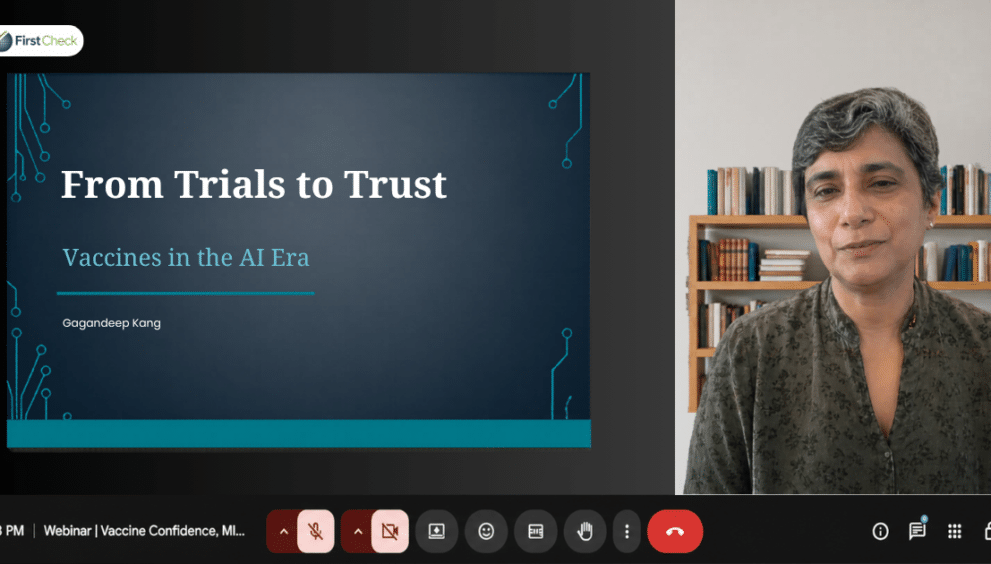
Against this backdrop, on the occasion of World Immunisation Week, First Check convened a webinar titled “Vaccine Confidence, Misinformation and Last-Mile Delivery”, bringing together leading voices from science, policy, and public health.
Among the key speakers was Dr Gagandeep Kang, Director, Global Health, Gates Foundation and one of the world’s foremost experts on vaccines and immunisation science. Drawing from decades of research and real-world experience, Dr Kang offered a nuanced perspective on how trust in vaccines is built, and how easily it can be undermined.
Lessons from rotavirus vaccines
Beginning from the perspective of a researcher, Dr Kang shared the story of rotavirus vaccines in India – a case that reflects both the rigour of science and the fragility of public trust.
“You know, sometimes when you look at vaccines, there are no signals and people make them up. Sometimes there is a small signal, and it gets amplified into a very large one. And sometimes there are signals that we should not be ignoring,” she said.
She recalled how the first rotavirus vaccine, Rotashield, introduced in the United States, was withdrawn after reports of intussusception – a condition where one part of the intestine slides into another – in a small number of children.
“After about one and a half million doses, 175 cases of intussusception were reported,” she explained, adding that while the condition occurs naturally as well, the clustering of cases after vaccination raised legitimate concerns.
This led to the development of safer alternatives by global pharmaceutical companies. However, affordability remained a major barrier for countries like India.
“At that time, about a quarter of a million children were dying in India of rotavirus. And we could not afford the Merck and the GSK vaccines because they cost $200 to immunise one child. So we had to think about making an Indian vaccine.”
This effort led to the development of Rotavac, an indigenous vaccine that underwent rigorous clinical trials and intensive monitoring.
“We made the vaccine, and we were able to show that at dose one, dose two, dose three, there were no cases of intussusception,” she noted.
But even with strong evidence, the journey was far from smooth.
“These data were misinterpreted, and a case was filed accusing us of being unethical,” Dr Kang said, highlighting how the selective use of information created a misleading narrative around vaccine safety.
Ultimately, further large-scale surveillance and published evidence helped establish the vaccine’s safety, and legal challenges were dismissed.
“India is saving lives in India and in the world,” she added, noting that the vaccine now contributes significantly to immunisation efforts in developing countries globally.
Trust is the outcome, not the starting point
One of Dr Kang’s central arguments was that trust in vaccines cannot be demanded; it must be earned through transparent, consistent processes.
“If we look at vaccines specifically, what does research do? We conduct randomised trials. Then we have post-marketing surveillance, and independent advisory bodies review the data,” she explained.
These layers of scrutiny ensure that vaccines are both effective and safe. However, scientific validation alone is not enough.
“But then comes public acceptance, and public acceptance will only come when the public believes that the process of science is generating trustworthy evidence,” she said.
In a line that encapsulated the broader challenge, she added, “Trust is the output, not the input. We should not expect people to trust us.”
Instead, she stressed the importance of giving people access to clear, honest information so they can make informed decisions.
The double-edged sword of AI and misinformation
Dr Kang also addressed the growing role of artificial intelligence in shaping public discourse around vaccines – both as a risk and an opportunity.
“Misinformation was already happening before AI. But what does AI do? AI allows for the acceleration of misinformation,” she warned.
With algorithm-driven platforms amplifying engaging content, regardless of accuracy, false claims can spread rapidly and widely.
“You can not only accelerate misinformation, but you can also make up much more misinformation than was previously possible,” she said.
This creates a significant challenge for public health communication, where disproving false claims often takes far longer than creating them.
However, she also pointed out that AI can be harnessed positively.
“We have the opportunity to identify signals early, do analyses at scale, and understand populations that we might otherwise miss,” she said, referring to its potential in surveillance and data analysis.
AI, therefore, is not inherently harmful, but its impact depends on how it is used.
“AI can stress the contract or it can strengthen it,” she noted.
The key to credibility
Reflecting on lessons from the COVID-19 pandemic, Dr Kang highlighted the importance of acknowledging uncertainty in science communication.
“Honest communication is very important to say what we know and what we don’t know,” she said.
Rather than projecting absolute certainty, scientists and public health officials should communicate evolving evidence transparently.
“Transparency about our processes earns more trust than making conclusions that will later change.”
She emphasised that overconfidence can erode credibility, especially when new data leads to revised recommendations.
“We need to be honest about limits. We should not be overconfident. That destroys trust, it doesn’t create it.”
The importance of integrated healthcare
Addressing vaccine hesitancy in underserved communities, Dr Kang made it clear that access alone is not enough.
“The problem with underserved communities has been, you come to us with vaccines, but you come to us with nothing else,” she said.
When vaccines are delivered in isolation, without broader healthcare support, they can be met with suspicion.
“If it’s the only thing that reaches an underserved population, it actually becomes very difficult to deliver those vaccines.”
Instead, she advocated for integrating immunisation into a comprehensive healthcare system that addresses multiple needs, from infectious diseases to chronic conditions.
“If you treat my tuberculosis, my cold, my cough, my cancer, and you tell me this vaccine is a good thing, then that becomes very different,” she explained.
This integrated approach not only improves health outcomes but also strengthens trust in public institutions.
Building trust in institutions
Dr Kang also reflected on the distinction between trust in vaccines and trust in health authorities – a gap that is often shaped by politics, governance, and lived experiences.
“When people interact with the government, they look at what the government do for me, what am I getting back?” she said.
Trust grows when people see consistent delivery of services, not just one-off interventions.
“If it is a package of things, then there is a greater amount of trust.”
She pointed to states like Kerala and Tamil Nadu as examples where stronger public health systems have helped build credibility over time.
“Health has never been high on the political agenda, but we have a right, and we should demand it,” she added, underlining the role of accountability in strengthening public health systems.
(Do you have a health-related claim that you would like us to fact-check? Send it to us, and we will fact-check it for you! You can send it on WhatsApp at +91-9311223141, mail us at hello@firstcheck.in, or click here to submit it online)