Author
India is home to an estimated 253 million adolescents, the largest in the world, making their health and well-being a critical public health priority. Yet, evidence suggests that many young people continue to face preventable health risks while lacking awareness about healthy lifestyles.
A 2025 comparative study published in the Journal of Public Health Research found that Indian adolescents reported lower levels of mental health awareness, nutrition knowledge, physical activity and awareness of sexually transmitted infection prevention than their counterparts in the United States. Another review, published in the Journal of Neurosciences in Rural Practice, highlighted how tobacco and substance use, physical inactivity and poor mental health continue to shape adolescent health, while emphasising the role of parental engagement, school-based interventions and adolescent-friendly healthcare in reducing these risks.
These findings mirror concerns already recognised under the Ministry of Health and Family Welfare’s National Health Mission (NHM), which identifies malnutrition, obesity, mental health disorders, substance misuse and injuries among the key health challenges affecting adolescents.
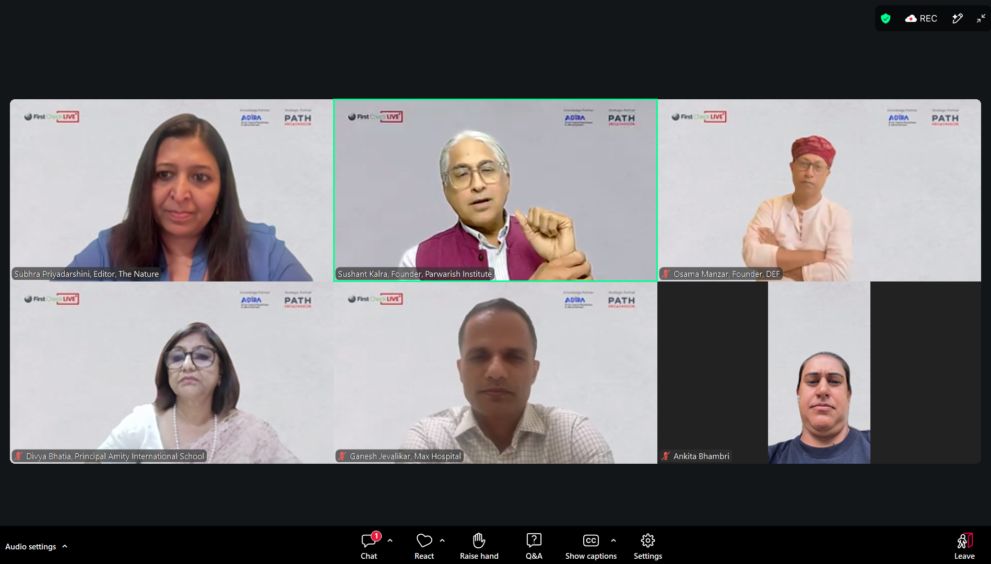
Against this backdrop, First Check LIVE hosted a webinar on Healthy Lifestyle and Risk Prevention for Teens and Adolescents, bringing together experts from medicine, education, parenting, digital inclusion and sport to discuss how healthier habits can be built early in life and sustained through adolescence.
Moderated by Subhra Priyadarshini, Chief Editor of Nature India, the discussion explored why improving adolescent health requires coordinated action from families, schools, healthcare professionals and communities.
Building healthy habits before problems begin
Opening the discussion, paediatric endocrinologist Dr Ganesh Jevalikar described adolescence as one of the most critical stages of human development, arguing that the biological and behavioural changes during these years have lifelong consequences.
“The third maximum growth happens during adolescence,” he said, explaining that puberty is marked by rapid changes in muscle mass, bone health and hormonal development. “Most of our fate is sealed with respect to our bone health in adolescence.”
Dr Jevalikar noted that the period is equally important for mental health, pointing out that “75% of mental health disorders originate before the age of 20–25”. He identified healthy eating, regular physical activity and adequate sleep as three lifestyle habits adolescents should prioritise.
“Eating is like a yagna (devotion). You are supposed to eat with full presence, full mental presence, pay attention to every item that you are eating, chew it properly, relish the taste and aroma,” he said, cautioning against distracted eating in front of televisions or mobile phones.
Dr Jevalikar added that exercise should become “a compulsory thing in our daily list”, while describing sleep as something that “recharges us for the next day”.
The discussion then turned to the influence of digital technologies. Osama Manzar, Founder and Director of the Digital Empowerment Foundation, argued that today’s adolescents are growing up in an unprecedented digital environment.
“Everybody who is an adolescent today is a screen child,” he said, adding that misinformation is not simply a technology problem but also reflects gaps in health education.
“Our school system, college system doesn’t have nutrition and health as a proper subject,” he added.
Manzar observed that adolescents increasingly seek health information through artificial intelligence because trusted guidance is often unavailable elsewhere. “Everybody’s asking AI. Why are they asking AI? Because they don’t have an answer locally in their own house, in their own ecosystem, in their own community,” he said, stressing that critical thinking must accompany digital access.
Founder of the Parwarish Institute of Parenting and author, Sushant Kalra, argued that parents should focus less on controlling children and more on preparing them to make responsible decisions.
“My only job as a parent… is to make your child responsible for their life,” he said. Referring to screen use, Kalra argued that complete restrictions are unrealistic because children inevitably encounter technology in schools and social settings.
“Control will never work, never has, never will,” he said. Instead, he encouraged parents to begin conversations about adolescence, digital media and sexuality several years before children encounter these issues directly.
Healthy lifestyles require support beyond the home
Divya Bhatia, Principal of Amity International School, said schools should integrate health and wellbeing into everyday learning rather than treat them as isolated awareness programmes.
“You cannot close screens, you cannot stop screens, but you can always train children to use them effectively,” she said, adding that schools should help students distinguish reliable information from misinformation while involving parents in conversations around responsible technology use.
Bhatia argued that health education should be embedded across school life. “Health is not an event,” she said. “I don’t think nutrition and health needs to be a subject. I feel it can be embedded into everything that we are doing in school.”
She described initiatives including daily fruit breaks, meditation sessions, hydration reminders and regular physical activity.
Reflecting on conversations with students, she also said blanket bans on social media may prove counterproductive. “There could be some controls, but banning social media will make us want to access it even more,” she noted.
Former India Fed Cup player and national tennis coach Ankita Bhambri similarly emphasised the importance of establishing healthy routines from an early age.
“It’s a collective effort. In whatever you do in life, you need the support of everyone around you. Parents, teachers, schools all need to be on the same page,” she said.
Drawing on her coaching experience, Bhambri said nutrition education is introduced alongside sport, with many young athletes developing an understanding of healthy eating well before adolescence. She also called for greater emphasis on physical activity during school holidays. “We need to emphasise on daily sport. There should be sport holiday homework. Join a sport, play a game, play something, do something,” she said.
Although approaching adolescent health from different professional perspectives, the panellists converged on one message: healthier lifestyles are built through consistent habits established early in life.
From nutrition, sleep and exercise to parenting, digital literacy and school environments, they highlighted that supporting adolescents requires sustained collaboration between families, educators, healthcare professionals and communities so that young people are equipped to make informed choices throughout adolescence and beyond.
Also read: Gaurav Madaan’s viral India’s Got Latent act sparks debate on why some people can’t gain weight