Author
CLAIM: A viral video alleges that the Indian version of Fanta contains artificial colours and flavourings instead of real orange juice, has nearly 2.5 times as many calories, and contains about 10 teaspoons of sugar per 300 ml, compared with four teaspoons in the French version, suggesting weaker food regulation in India.
FACT: Label checks confirm Indian Fanta uses colour 110 and lists no real fruit, while French Fanta contains only 5% orange juice from concentrate. Sugar and calorie content also differ between the two versions, as shown on their respective nutritional panels.
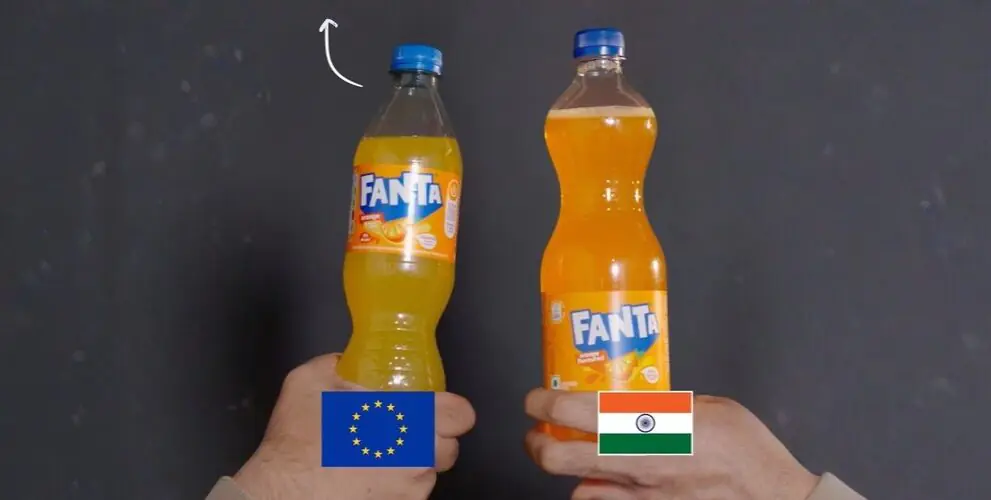
A bottle of Fanta bought in India and another bought in France look strikingly different, and that contrast has become the focus of a widely shared video by food safety commentator Revant Himatsingka, better known online as Food Pharmer.
In the video, Himatsingka holds up two bottles of what appears to be the same soft drink. The French version is a pale, muted orange, while the Indian one is a much brighter, deeper shade. Holding up the European bottle, he compares its colour to homemade orange juice, saying it is naturally lighter.
“Why is there so much colour difference between these two Fantas,” he asks. “India’s Fanta is bright orange because they use artificial colours, so that we are attracted,” he said.
“In European Fanta they write orange because they use real orange,” Himatsingka claims.
“But in India they write orange flavoured because they are not real oranges in India.”
He also points to differences in sugar content. According to Himatsingka, a 300 ml bottle of European Fanta contains close to four teaspoons of sugar, while the Indian version contains around 10 teaspoons for the same quantity.
“Indian Fanta carries about two and a half times more calories than the European version,” he says, referring to France’s front-of-pack nutrition label, which grades packaged food and drinks from A to E based on their nutritional value. “I believe India should learn from France about their food laws so that India can also become healthy.”
India does not currently have a mandatory front-of-pack, colour-coded nutrition labelling system like the one used in France, although the Food Safety and Standards Authority of India has previously discussed introducing such labels.
The claims made in the video have not been independently verified by Coca-Cola, which owns the Fanta brand, and the company has not publicly responded to the allegations so far.
Comparison of bottle labels
The label on the Indian bottle backs up part of Himatsingka’s claim.
It lists carbonated water, sugar, acidity regulator (330), stabilisers (414, 445), preservative (211) and colour (110) among its ingredients. The nutritional panel on the pack shows 56 kcal and 13.7 grams of sugar per 100 ml, all of it listed as added sugar, which works out to 54.8 per cent of the recommended daily allowance per 200 ml serving, based on a 2000 kcal diet.
A separate nutritional label on the French Fanta bottle, listing values per 100 ml, shows an energy value of 114 kJ or 27 kcal, along with 0 g of fat, 0 g of saturated fatty acids, 6.5 g of carbohydrates, 5.9 g of sugars, 0 g of protein and 0 g of salt. The figures indicate a lower sugar and calorie count compared to the Indian version, which lists 56 kcal and 13.7 grams of sugar for the same quantity.
The ingredients list on the French Fanta bottle also shows a notable difference: It specifies orange juice from concentrate (5%) and lemon juice from concentrate (1%) among its ingredients, along with carotenoids, a naturally derived colouring compound, used for colour.
However, the actual proportion of real fruit content remains small, with orange juice making up only 5% of the drink. The Indian version, by contrast, does not list any real fruit content, relying instead on flavouring and a synthetic dye to achieve its taste and appearance.
What do the studies say?
A 2019 academic study, published in the journal Globalizations and titled ‘The fanta-sy of global products’, looked at why a drink as simple as Fanta tasted and looked different depending on where it was sold. The study used the idea of an “assemblage,” a way of describing how a product could look the same everywhere while being made differently in each place.
The study argued that Fanta stayed instantly recognisable across the world, but the actual ingredients, sugar, flavours and colours, changed from country to country depending on local rules, taste and market pressures. The study noted that the Coca-Cola Company profited from what was essentially sugar and water, while local bottlers, regulators and marketing teams shaped how the drink was adapted for each region.
In short, the study suggested that Fanta’s global identity survived precisely because it changed quietly from place to place.
A 2026 study published in the journal Greener Trends in Food Science and Nutrition looked at the microbial quality of Coca-Cola and Fanta Orange at a beverage production plant in Nigeria. Researchers tested the water, sugar, syrup and final products at every stage of manufacturing.
The study found that bacteria and fungi were present at various stages of production, with Fanta Orange showing higher bacterial and fungal counts than Coke, both on the day of production and after ten days of storage. The study identified the bacteria as Bacillus, Leuconostoc and Lactobacillus species and the fungi as Fusarium, Penicillium, Aspergillus and Geotrichum species.
The study noted that “sub-standard raw materials including water” had earlier been linked to quality problems in soft drinks manufactured in Nigeria. The study concluded that the differences between the two drinks were “attributed to difference in the chemical composition of the products,” and that the production environment itself needed closer monitoring to maintain hygiene standards.
What do experts think?
Dietitian and ayurvedic nutritionist Prernna Kalra weighed in on the claims made in the viral video, saying the sugar content in Indian Fanta could pose a real health risk if consumed frequently. “At 13.7 g per 100 ml, a 300 ml bottle provides around 41 g of sugar, which is about 10 teaspoons. That’s a significant amount from a single drink,” she said, adding that regular intake raises the risk of weight gain, insulin resistance, type 2 diabetes, fatty liver and dental cavities. Occasional consumption, she said, was unlikely to cause harm.
Kalra also addressed the use of Colour 110, or Sunset Yellow, noting that some children could be more sensitive to artificial colours. She said studies had linked the additive to increased hyperactivity in certain cases, though not universally, and that while the colour was approved within safety limits, parents who noticed behavioural changes in their children should consider limiting such products.
Regulatory standards, according to Kalra, differed between the two regions. “Europe generally follows a more precautionary approach, especially when it comes to labelling and consumer information,” she said, adding that India too had approved limits for additives, though implementation and communication varied.
She, however, made it clear that this did not make Indian products unsafe.
Kalra pointed out that an orange-flavoured drink offered little nutritional value compared to one made with real orange juice, and consumers should not assume otherwise just because of the taste.
Also readL FACT CHECK: Are 2-minute noodles and soft drinks as dangerous as viral posts claim?