
Author
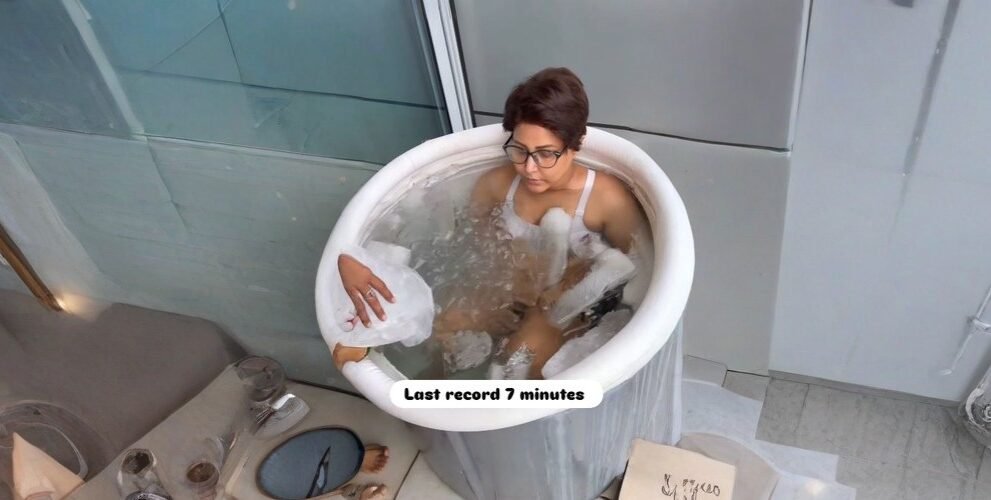
Actress Hina Khan is again in the news as she braves an ice bath therapy, offering another glimpse into the routine she has been following under medical supervision.
In a video shared on Instagram, Khan is seen immersing herself in a tub of ice-cold water while carefully following breathing instructions from a doctor. She also revealed that she had surpassed her previous record, extending her ice bath from seven continuous minutes to 12 minutes.
“Last record: 7 minutes. Let’s try to break it. 70 kg ice. And it’s 12 minutes,” she said in the video, adding that she was doing it under “strict supervision” of doctors. Hina Khan, who announced in June 2024 that she had been diagnosed with stage 3 breast cancer, also explained why she chose to stop at the 12-minute mark, saying, “I stopped here because we should take it slow and easy.”
Captioning the post, she wrote, “Ice therapy = Heaven.” She also urged people not to imitate the practice without expert guidance, writing, “I do it under strict doctors supervision, do not attempt it without professional guidance. Take it easy and go slow. Listen to your body.”
The post has sparked conversations about whether ice bath therapy can actually help people undergoing cancer treatment or recovering from cancer. While cold-water immersion has become a popular recovery tool among athletes and fitness enthusiasts, many are now wondering whether it offers any benefits beyond muscle recovery, especially for serious illnesses such as cancer. But does the scientific evidence support its use in cancer patients?
Is ice therapy helpful for cancer patients?
Available evidence does not show that ice baths improve cancer treatment outcomes or help the body fight cancer. While cold-water exposure may have certain effects on stress, wellbeing or recovery in some settings, there is currently insufficient evidence to recommend ice therapy as a treatment or supportive therapy for cancer patients outside properly supervised clinical research.
An early hypothesis paper proposed that repeated brief cold-water exposure might stimulate the body’s anti-tumour immune response. The authors suggested that daily cold-water stress could temporarily activate immune cells such as cytotoxic T lymphocytes and natural killer (NK) cells, which play an important role in fighting cancer. However, this was not a clinical trial in cancer patients. Instead, the researchers proposed testing the idea in mice before it could be considered in humans.
The authors concluded that, “If the hypothesis is supported by empirical studies and the method is shown to be safe, this could lead to the development of an adjunctive immunotherapy for some (non-lymphoid) cancers.” In other words, the paper raised a scientific possibility but did not provide evidence that cold-water therapy benefits cancer patients.
More than a decade later, a 2022 systematic review examined whether different forms of water therapy could benefit people with cancer. The review analysed 12 studies involving 430 patients, most of whom had breast cancer. The interventions included aquatic exercise, aqua lymphatic therapy, foot baths and whole-body baths – not specifically ice baths or cold-water immersion.
Some studies reported improvements in quality of life, fatigue, lymphoedema, neck and shoulder pain, and body mass index (BMI), while others found no meaningful benefit. Because the studies were small and used different types of water therapy, the researchers concluded that the evidence was inconsistent.
They wrote, “Due to the very heterogeneous results and methodical limitations of the included studies, a clear statement regarding the effectiveness of water therapy on cancer patients is not possible.”
A 2023 review also examined the potential role of cold therapy in cancer treatment. It discussed several approaches, including cold exposure, cryotherapy, cryoablation, cryoimmunotherapy and other cryogenic techniques. The authors noted that although findings from experimental animal studies appear promising, clinical research in humans remains limited.
The review concluded that, “While clinical trials using cold therapy for cancer treatment are still limited, recent research shows promising results in experimental animal cancer models. This area of research is becoming increasingly significant and warrants further investigation.”
More recently, a 2025 systematic review and meta-analysis evaluated the health effects of cold-water immersion (CWI) in healthy adults rather than cancer patients. The review included 11 randomised trials involving 3,177 participants who underwent cold showers or ice baths at temperatures between 7°C and 15°C.
The researchers found that cold-water immersion produced a temporary increase in inflammation immediately after exposure and reduced perceived stress about 12 hours later. Some individual studies also suggested possible improvements in sleep quality, quality of life and a lower rate of sickness absence. However, the review found no significant immediate improvements in immune function, and the evidence was limited by the small number of high-quality studies.
The authors concluded that cold-water immersion may have potential applications for stress management and overall wellbeing, but emphasised that more robust clinical trials are needed to understand its long-term health effects.
Expert insights: What are the risks and benefits?
Dr Mythili Kundur, Oncologist, Aster CMI Hospital, Bengaluru, said there is currently no strong scientific evidence to support the routine use of whole-body ice baths or cold-water immersion as a treatment or recovery strategy for people with cancer.
She explained that most research on ice baths has been conducted in athletes, where the therapy may help reduce muscle soreness after intense exercise. “In cancer care, evidence is limited and does not show that ice baths improve survival, prevent recurrence, or speed overall recovery,” she said.
Dr Kundur noted that while certain forms of local cooling, such as scalp cooling caps, cooling gloves and cooling socks, have been studied to reduce chemotherapy-related side effects like hair loss or nerve damage, these interventions are not the same as whole-body ice baths. “More high-quality clinical studies are needed before recommending this practice,” she added.
Addressing claims that cold-water immersion may boost immunity or reduce inflammation in cancer patients, Dr Kundur said the available evidence does not support these benefits.
“Current research does not show that whole-body ice baths can improve cancer-related outcomes such as boosting immunity, reducing inflammation linked to cancer, or improving recovery from cancer treatment,” she said.
While cold exposure may temporarily reduce muscle soreness or inflammation in healthy individuals, she emphasised that these effects have not been proven to benefit cancer patients. “There is also no reliable evidence that ice baths strengthen the immune system in a way that helps fight cancer,” she said.
According to Dr Kundur, some people may feel mentally refreshed or experience a temporary improvement in mood after cold-water immersion, but these are subjective experiences rather than proven medical benefits. She stressed that supportive cancer care should continue to focus on evidence-based measures such as proper nutrition, physical activity, rehabilitation, pain management and psychological support.
Dr Kundur also cautioned that ice baths are not without risks, particularly for people undergoing cancer treatment. She explained that sudden exposure to very cold water can increase heart rate and blood pressure, placing additional stress on the cardiovascular system.
“Patients receiving chemotherapy may already have nerve damage, poor circulation or weakened immunity, making them more vulnerable to injury or infection,” she said. She added that people recovering from surgery may also experience discomfort or delayed wound healing after exposure to extreme cold.
She advised that people with heart disease, uncontrolled high blood pressure, severe anaemia, peripheral neuropathy, Raynaud’s phenomenon or open wounds should avoid ice baths unless specifically advised by their treating doctor.
Dr Kundur emphasised that oncologists should not routinely recommend whole-body ice baths as part of supportive cancer care.
“At present, ice baths remain an experimental wellness practice rather than an established cancer therapy,” she said. “Patients should not replace proven supportive care strategies with cold-water immersion or assume it can reduce treatment side effects or improve cancer outcomes.”
She added that anyone considering ice baths during or after cancer treatment should first consult their oncologist to ensure the practice is safe in their individual medical situation.
Also read: Why the viral ice bath challenge can be dangerous during a heatwave
Do you have a health-related claim that you would like us to fact-check? Send it to us, and we will fact-check it for you! You can send it on WhatsApp at +91-9311223141, mail us at hello@firstcheck.in, or click here to submit it online.