
Author
With diminishing trust in the food around us, checking labels has become increasingly important. Yet, when shopping online, consumers often cannot see key information such as a product’s Best Before or Use By date before placing an order.
A recent LocalCircles survey found that 48% of Indian online grocery shoppers surveyed still could not find Best Before date information on most platforms. Following the findings, LocalCircles took up the issue with the Food Safety and Standards Authority of India (FSSAI), which, in a written response, recommended that the Department of Consumer Affairs and Legal Metrology enforce the requirement for online platforms to display Best Before or Use By dates.
The development comes amid continuing concerns over how consumers understand and interpret food date labels. A 2025 review highlights that expiration date labels are frequently misunderstood by consumers, with confusion contributing to the disposal of food that may still be edible. The review found that consumers’ understanding of date labels varied considerably and was influenced by contextual factors. It also noted that while consumer education and information campaigns are commonly recommended, standardising date labels and improving how the information is presented could make them easier to understand and potentially reduce unnecessary food waste.
What are the rules for displaying Best Before dates online?
Under the Legal Metrology (Packaged Commodities) Amendment Rules, 2017, declarations applicable to packaged commodities are required to be made available when products are sold through e-commerce platforms. This includes relevant date information such as Best Before or Use By details.
However, according to LocalCircles, the requirement has not been consistently enforced for food products sold online because food is also regulated under the FSSAI framework.
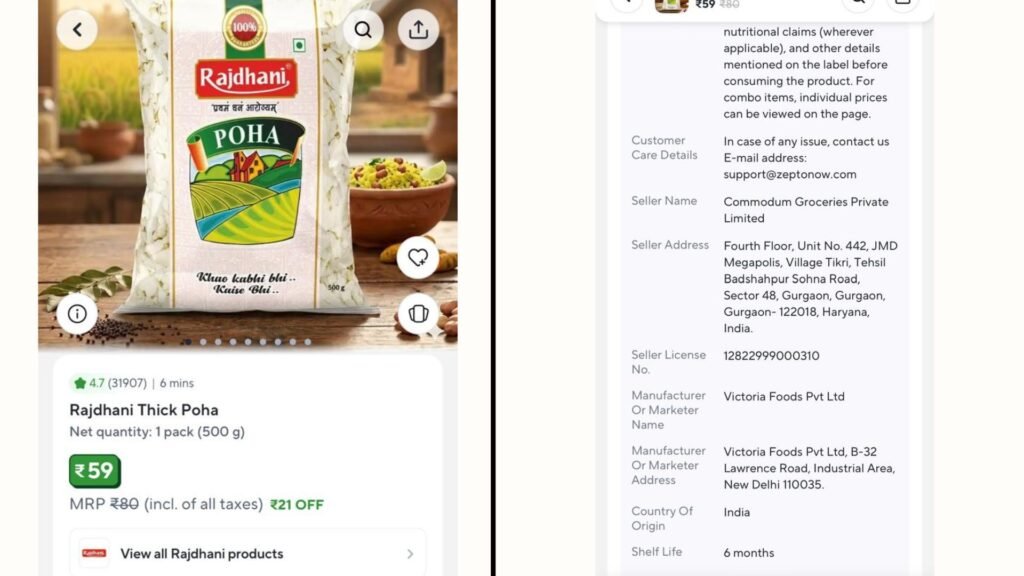
Screenshots from Blinkit showing that the best-before date is not displayed for this product. (Photo edited on Canva)
LocalCircles has been raising the issue with FSSAI since 2024. The consumer platform says that, instead of directly enforcing the online display of Best Before dates, FSSAI has focused on provisions introduced through the Food Safety and Standards framework concerning the minimum shelf life that packaged food should have when delivered to consumers.
Under the relevant requirement, e-commerce and quick-commerce platforms are expected to ensure that packaged food products have at least 30% of their shelf life remaining or 45 days before expiry, whichever is applicable, at the time of delivery.
The problem, however, is that consumers may not be able to determine the remaining shelf life before placing an order if the date information is not displayed on the platform.
Following LocalCircles’ escalation in October 2024, FSSAI issued warnings to some e-commerce and quick-commerce platforms regarding the sale of consumable products with missing or near-expiry dates. Platforms were asked to ensure compliance with the applicable shelf-life requirements.
But LocalCircles says that these directions did not require platforms to display the Best Before date directly on their apps or websites.
The consumer group has also received complaints about products being delivered with very little shelf life remaining. Bread, for example, has frequently been cited in consumer complaints, with some consumers reporting that products delivered online had only one or two days of shelf life remaining despite an average shelf life of around five to seven days.
The latest survey was conducted to assess whether consumers had seen any improvement in the online display of date information since 2024.
Nearly half of online grocery shoppers still cannot find Best Before dates
The LocalCircles survey received more than 17,000 responses from consumers of online platforms across 164 districts in India. Among the respondents, 61% were men and 39% were women. About 53% were from tier 1 districts, 29% from tier 2 districts and 18% from tier 3 and 4 districts. Participants were validated citizens registered on the LocalCircles platform.
Consumers were asked: “When you shopped on online grocery platforms in the last 12 months, how did you find the Best Before date (shelf life remaining) of the human consumption products (packaged food, groceries, medicines, cosmetics, etc.,) displayed online?”
Out of 17,133 respondents, 13% said the Best Before date was displayed on all apps or websites they used. Another 5% said it was displayed on most apps or websites, while 21% said it was displayed on some apps or websites.
A further 13% said the information was displayed on just a few apps or websites. However, 35% said they could not find the Best Before date on any app or website, while 13% did not provide a clear response.
Based on these responses, LocalCircles concluded that 48% of Indian online grocery shoppers surveyed could not find Best Before date information displayed on most online platforms.
The survey indicates a minor improvement compared with the consumer group’s 2024 findings. According to LocalCircles, the proportion reporting non-compliance has declined from 57% in 2024 to 48% this year.
Despite the improvement, the consumer group says the findings show that roughly one in two consumers surveyed still cannot reliably access Best Before date information when shopping online.
Which online platforms are displaying date information?
LocalCircles also examined the experience of consumers across eight major online grocery platforms. Based on consumer complaints and its assessment, it found five platforms to be non-compliant with the requirement to display Best Before dates for packaged food products sold through their platforms.
According to LocalCircles, Amazon Now, BigBasket and Flipkart Minutes were found to be compliant, while Milkbasket, JioMart, Blinkit, Swiggy Instamart and Zepto were identified as non-compliant.
The survey also highlighted another problem: some platforms may provide information about a product’s shelf life without specifying the actual Best Before date or providing a manufacturing date from which the shelf life can be calculated.
The consumer group argues that simply stating a shelf life may not give consumers enough information to determine when a particular product will expire or reach its Best Before date.
Online shopping also creates a different consumer experience compared with physical retail. In a store, shoppers can pick up a packet, inspect its label and decide whether the remaining shelf life is acceptable. When buying online, they generally rely on the information made available on the product listing.
This makes accurate and accessible date information particularly important for perishable and packaged food products.
LocalCircles has therefore urged authorities to ensure that online platforms provide consumers with the same essential information that would be available when purchasing products in physical stores.
The organisation has also called for stronger enforcement of the existing shelf-life requirements and for Best Before dates to be displayed online for packaged food products.
Expert advice for consumers
Dr Anupama N K, Senior Consultant – Medical Gastroenterology, Aster CMI Hospital, Bengaluru, said clear Best Before or Use By information is important for helping consumers make safer and more informed decisions, particularly when purchasing products with limited shelf life, such as dairy products, ready-to-eat foods, meat and other packaged foods.
“The Best Before or Use By date helps consumers make a safer and more informed decision about the food they are purchasing,” she said. This becomes particularly important when shopping online because consumers cannot physically inspect the packaging before placing an order. Without clear date information, they may not be able to determine how much usable shelf life a product has and could unknowingly purchase an item that is close to its date.
Dr Anupama also pointed out that storage after delivery can affect the safety of food. “This becomes more concerning when food is stored incorrectly after delivery, as poor storage can increase the risk of spoilage and foodborne illness,” she said.
Explaining the difference between the various date labels, she said a Best Before date primarily relates to food quality rather than automatically indicating that the product becomes unsafe immediately after that date. It generally refers to the period during which a packaged food is expected to retain its intended qualities, including taste, texture and freshness, when stored correctly.
“Crossing the Best Before date does not automatically mean the food has become unsafe,” she said. However, Use By or expiry dates are more closely associated with food safety. Consuming certain foods after these dates can carry a higher risk, particularly when the food is highly perishable or requires controlled storage.
Dr Anupama stressed that the risk cannot be determined by the date alone. “The actual risk also depends on the type of food, packaging, storage conditions and whether there are signs of spoilage,” she said. Consumers, therefore, should not treat Best Before and Use By dates as interchangeable and should follow the storage instructions provided by the manufacturer.
She also advised consumers to be particularly careful when groceries are delivered. They should check the Best Before or Use By/expiry date, manufacturing details, condition of the packaging and any storage requirements before consuming the product, especially in the case of perishable foods.
“If an item is already past its Use By or expiry date, has damaged or swollen packaging, an unusual smell, visible mould, leakage or any other sign of spoilage, it is safer not to consume it, even if the food looks acceptable otherwise,” she said.
For products that are close to their Best Before or other relevant date, consumers should consider whether they can realistically use the product within the recommended period and ensure that it is stored appropriately.
If a delivered product appears unsuitable, Dr Anupama advised consumers to document the issue. They should photograph the product packaging and date, retain the order details and request a refund or replacement from the platform or seller.
Also read: How online food delivery and quick commerce apps are impacting health in India | Explainer