

Author
How often are women told they are overreacting, that it’s “just a phase”, or simply advised to “drink more water” and everything will be okay? But when you are suddenly dealing with hot flashes, feeling unusually cold at times, poor sleep, mood changes or unexplained fatigue, there may be more going on than just a bad day. These could be signs of perimenopause, the transitional phase before menopause.
We spoke to Dr Deepthi Ashwin, Senior Consultant – Obstetrics and Gynaecology, Aster Women and Children, Bangalore, to understand perimenopause, the changes women may experience during this phase, and the simple steps that can help manage symptoms and support overall health.
What is perimenopause, and when does it usually begin?
Perimenopause is the stage of life when the ovaries gradually become less consistent in releasing eggs and hormone patterns begin to change before menopause. It is also called the menopausal transition. Menopause itself is reached only after a woman has gone 12 consecutive months without a menstrual period, provided there is no other explanation for the absence of periods.

The onset of perimenopause is not a definite age. Typically, the menopausal transition happens in the age group of 45 to 55 for women; however, this can even be earlier. While some women might experience some symptoms like irregular periods during their late 30s, menopause that happens before 45 years of age is early menopause. Premature ovarian function cessation needs a different diagnosis.
What happens to hormones during perimenopause?
The key difference lies in the hormone production in the ovaries. This is where oestrogen and progesterone start to vary and reduce, rather than steadily decreasing in quantity each day. Ovulation becomes irregular as well. It is these changes in hormone levels that result in many of the signs experienced during menopause.
As the symptoms do not decrease consistently each day but rather fluctuate, women tend to have periods of time when everything goes smoothly and after which the symptoms appear once again.
How can you tell if it’s perimenopause?
The perimenopause period can impact women in very different ways. Women could either suffer from problems with menstruation or several signs that hinder everyday activities.
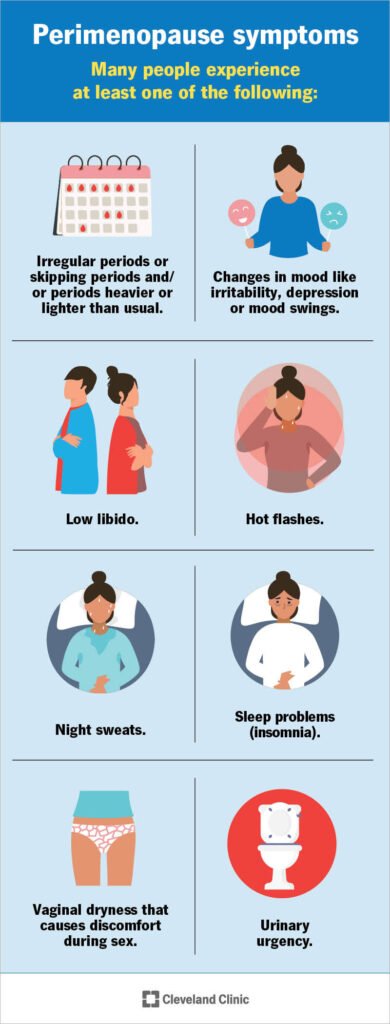
Some common symptoms of perimenopause are flushes and night sweats, insomnia, emotional disturbances, irritability, lack of concentration, headaches, palpitations, vaginal dryness, low libido, urinary symptoms, joint pains, muscle pains, body shape changes and weight gain, especially in the abdominal area.
Insomnia itself may worsen problems with concentration, memory, and mood. Vaginal dryness and urinary problems are becoming more obvious since changing levels of oestrogen influence the tissues of the genital and urinary system.
Does perimenopause make periods irregular?
Periods do not often cease abruptly. The menstrual pattern can instead start becoming unpredictable, with cycles becoming either longer or shorter and periods being either heavier or lighter. Women might occasionally miss a period but have a perfectly normal cycle later. Ultimately, the periods will eventually decrease in frequency and cease altogether.
It must be emphasised that not all bleeding changes need to be attributed to perimenopause. Women having extremely heavy bleeding, irregular spotting, bleeding after intercourse, periods longer than a week, or excessively frequent periods need to consult their doctor.
It is imperative for women to understand that even though they are in perimenopause, pregnancy is still a possibility due to ovulation. Contraception is thus necessary until menopause is confirmed.
How long does perimenopause last?
The time span can differ greatly. It is possible for a woman to experience the menopausal transition for years; it is also possible for menopause symptoms to last for years. According to the National Institute on Aging, menopause symptoms can last between two to eight years.
Therefore, there is no specific number of months during which all the symptoms will subside.
Can perimenopause be treated?
Perimenopause is a biological transition process, and therefore does not need any treatment per se. However, symptoms that affect sleep, work productivity, relationship satisfaction, or quality of life need to be treated.
The choice of treatment will be determined by the woman’s symptoms, age, medical background, and risk factors. Hormone replacement therapy could be considered in suitable women for menopausal problems like hot flashes and night sweats. Both Oestrogen and Progestron are used as a combination and is given in HRT for treatment for Perimenopausal / menopausal symptoms
Medications and non-pharmacological interventions like cognitive behavioural therapy may be helpful for some women where hormonal therapy is inappropriate or is not preferred. Local treatments like vaginal oestrogens could be considered in some patients for problems with vagina and/or urine.
Hormones or supplements should never be started by women without medical supervision. Herbal and “natural menopause” products are not always safe and effective.
What exercises and activities can women do at home?
Physical activity becomes especially important at this point in a woman’s life, as she may go through changes regarding her muscle mass, body composition, and bone density.
It can include weight bearing activities, strength training, aerobic exercises and flexibility work at home. Walking fast, going up and down stairs, and even dancing can serve as weight bearing activities. Squats, lunges, wall pushups, using resistance bands and light weights can preserve muscle strength. Flexibility and relaxation can be achieved by doing yoga, stretching and tai chi.
A complex exercise program doesn’t necessarily mean that a woman needs to spend hours in the gym. More important here is regularity rather than intensity, and exercise must be gradually increased depending on one’s fitness level and existing medical conditions.
Calcium and vitamin D, proper nutrition, enough sleep, avoidance of smoking and moderate alcohol consumption can contribute to good health in the long run.
Perimenopause is not just the time when menstruation stops. This is a period of substantial changes both physically and hormonally. Being aware of those changes can help women understand what belongs to normal perimenopausal symptoms, and what requires medical examination.
Also read: Karnataka plans first dedicated women’s health policy, menopause a key focus