Author
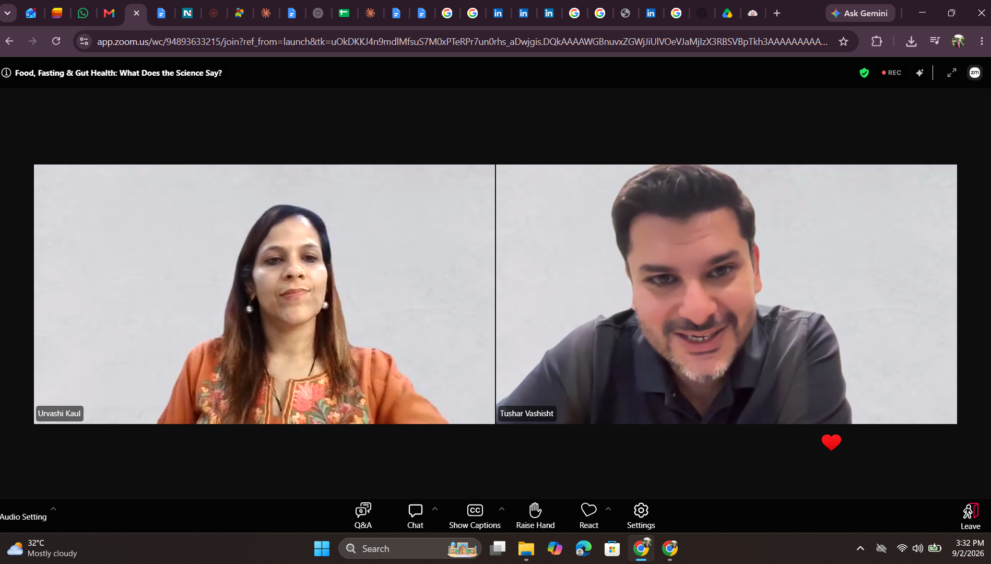
“Trust is not given by default. Trust is something that is earned, and there is no difference when it comes to AI,” said Tushar Vashisht, Co-founder and CEO of Healthify, formerly HealthifyMe, in a conversation with First Check LIVE. during the second dialogue in the Health and Trust in the Age of AI series, titled Food, Fasting and Gut Health: What Does the Science Say.
The series, running from July 2026 to July 2027, is being held as a set of online live sessions built around four health pillars over 12 editions, bringing in over 100 speakers to reach an audience of more than a billion people.
It was built on the idea that the real challenge today is not a shortage of health information but that of trust, clarity and usability, so that people can find guidance they can actually rely on.
First Check LIVE is an initiative of First Check, a global health information platform that brings together scientists, doctors and journalists to make reliable, evidence-based health information more accessible.
Healthify is a digital health company focused on obesity and metabolic health, and has recently announced a merger with Berry Street, a US-based dietitian access company. “I am technically the co-CEO of Berry Street Healthify now, and that gives me a global mandate,” Vashisht said.
Trust has to be earned
Vashisht said an average AI could already do better than an average person on most tasks, but that was not really the point. “You can get decent, general advice from an AI without much trouble. The real question is whether you can trust it to be better than the best advice you already have access to. That is not something that happens automatically. It is a process,” he noted.
He broke that process down into three parts. The first was data. “AI cannot be personal without data, and that data is only as useful as the context behind it. If it does not know your medical history, your family history, your current health, then how can it give you good advice?” he said.
The second was proof. Vashisht spoke about Healthify’s AI dietitian, Ria, and a 2023 study led by Stanford’s Professor Sridhar Narayanan that drew on data from 60,000 people. “It was the first study in the world to show that AI can actually help people achieve measurable weight loss,” he said, adding that Ria working alongside a human dietitian led to “70% higher weight loss compared to using neither AI nor a dietitian.”
The third was safety. “The AI needs to know when to bring in an actual human, when to hand things over to a real professional who has lived experience the AI simply does not have.” He also pointed out, “That kind of safety and oversight matters, because it is what keeps hallucinations and errors to a minimum.”
On privacy and personal data
Vashisht also spoke about how personal health data was handled at Healthify, saying the company followed the data protection laws of every country it operated in.
“We make sure that personal health data is never used to train any model. Your information stays secure and stays with you,” he said, comparing it to a bank locker. “Think of it like keeping your data in your own locker, one that follows the laws of wherever it happens to be sitting.”
A demo in three languages
To show how personalised the advice could get, Vashisht spoke live with Ria, asking what he should eat on an upcoming trip to Kolkata, then switching languages mid-conversation.
Ria replied in Bengali, suggesting bhapa ilish, chingri malai curry and cholar dal, then switched to Hindi with suggestions for Gurgaon, recommending grilled chicken tikka rolls and curd-based chaat.
When Vashisht asked how his past meals had affected his glucose levels, Ria recalled that chicken biryani and egg roti had caused sharp spikes, while salmon with steamed vegetables had kept things stable.
“I have built up trust with it over time,” Vashisht mentioned, “and a lot of that comes from the safety measures we have built in to keep it from making things up.”
On eating out and myths
Talking about restaurant food safety, Vashisht said the bigger goal should be sustainability rather than restriction. “The single most important thing anyone can do is pick something they can actually stick with,” he said, adding that home-cooked meals should make up “close to 80 or 90%” of what people eat, with eating out kept as “an occasional treat rather than a habit.”
He also laid out a few things people should look for before trusting any AI with their health.
“Check whether there is any real validation behind what the AI is claiming, whether there is published research backing it up,” he said, adding that a strong user base and good ratings were worth checking too. “In the end, it always comes back to how that trust is built.”
Also read: Does sleeping with your phone near you cause brain cancer or lower sperm count?
Do you have a health-related claim that you would like us to fact-check? Send it to us, and we will fact-check it for you! You can send it on WhatsApp at +91-9311223141, mail us at hello@firstcheck.in, or click here to submit it online.